
Every year, billions of dollars in furniture get shipped back. Not because the product was broken. Not because the quality was poor. Because it didn’t look right in the room.
In 2024, US ecommerce returns crossed $362 billion, and furniture sits in one of the most punishing corners of that number. Processing a single furniture return costs anywhere from 20% to 65% of its item value, according to Shopify data. A returned sofa isn’t like a returned t-shirt. It needs a freight pickup, inspection, repackaging, and often a discount resale, all before you see a cent back.
The furniture e-commerce category is uniquely exposed here. Unlike fashion, where Virtual Try-On tools like those used by Warby Parker, Kohl’s, and Ulta have reduced apparel and eyewear returns for years, furniture has historically had no equivalent. A jacket fits or it doesn’t; you can tell quickly. A sectional sofa takes a delivery crew, two weeks, and a return freight booking to discover the same.
Augmented Reality (AR) powered by photorealistic 3D visualization is the most measurably effective tool available today to fix this. And the data is no longer theoretical. Platforms like Threekit, London Dynamics, and My AR Studio have joined established players in building dedicated AR furniture solutions, reflecting just how large and validated this market has become.
This article covers:
- Root-cause analysis of why furniture gets returned
- How AR directly attacks each cause
- Real case studies from IKEA, Wayfair, and Macy’s, with numbers
- An ROI framework you can apply to your own brand
- A practical implementation roadmap: WebAR, native app, SaaS, or Shopify AR
This is for: furniture e-commerce brands, DTC founders, digital transformation leads, and anyone who has looked at a returns report and felt the pain in their chest.
The Furniture Returns Crisis: Why It’s So Costly
The Scale of the Problem
According to the National Retail Federation (NRF) 2024 Returns Report, total US retail returns reached $890 billion, making returns one of the largest hidden costs in commerce.
- Ecommerce specifically sees an average return rate of 20.4% across categories.
Furniture sits at 15–20% return rates by most estimates, which sounds manageable until you factor in ticket size.
- The average order value (AOV) for furniture online is around $546.
- At a 40% processing cost, that’s roughly $218 lost per return, before you even account for shipping, restocking, and depreciation.
That single metric, AOV, is why furniture returns hit margins so differently from any other category.
Returns management platforms like WeSupply have documented this pattern extensively across D2C brands.
- The furniture category consistently generates the highest per-return processing cost of any home goods segment.
- For D2C furniture brands in particular, where there’s no physical store to absorb a return, every sent-back sofa is a direct hit to margin.
Metric | Data |
US ecommerce returns (2024) | $362 billion |
Average ecommerce return rate | 20.4% |
Furniture return rate (ecommerce) | 15–20% |
Average furniture AOV | $546 |
Return processing cost (% of item value) | 20–65% |
Estimated loss per furniture return | $109–$355 |
Sources: NRF 2024 Returns Report, Shopify Research
Why Furniture Returns Are Different
Returning a jacket costs $8 on a prepaid label. Returning a sectional sofa requires freight logistics, a pickup window, white-glove handling, and usually a warehouse inspection team. The economics are completely different.
There’s also a consumer behavior layer here. Most furniture buyers don’t return out of remorse. They return because the product genuinely didn’t fit their space, physically or visually. That’s not a product problem. That’s an information problem. And information problems are solvable.
Root Causes: The 3 Expectation Gaps
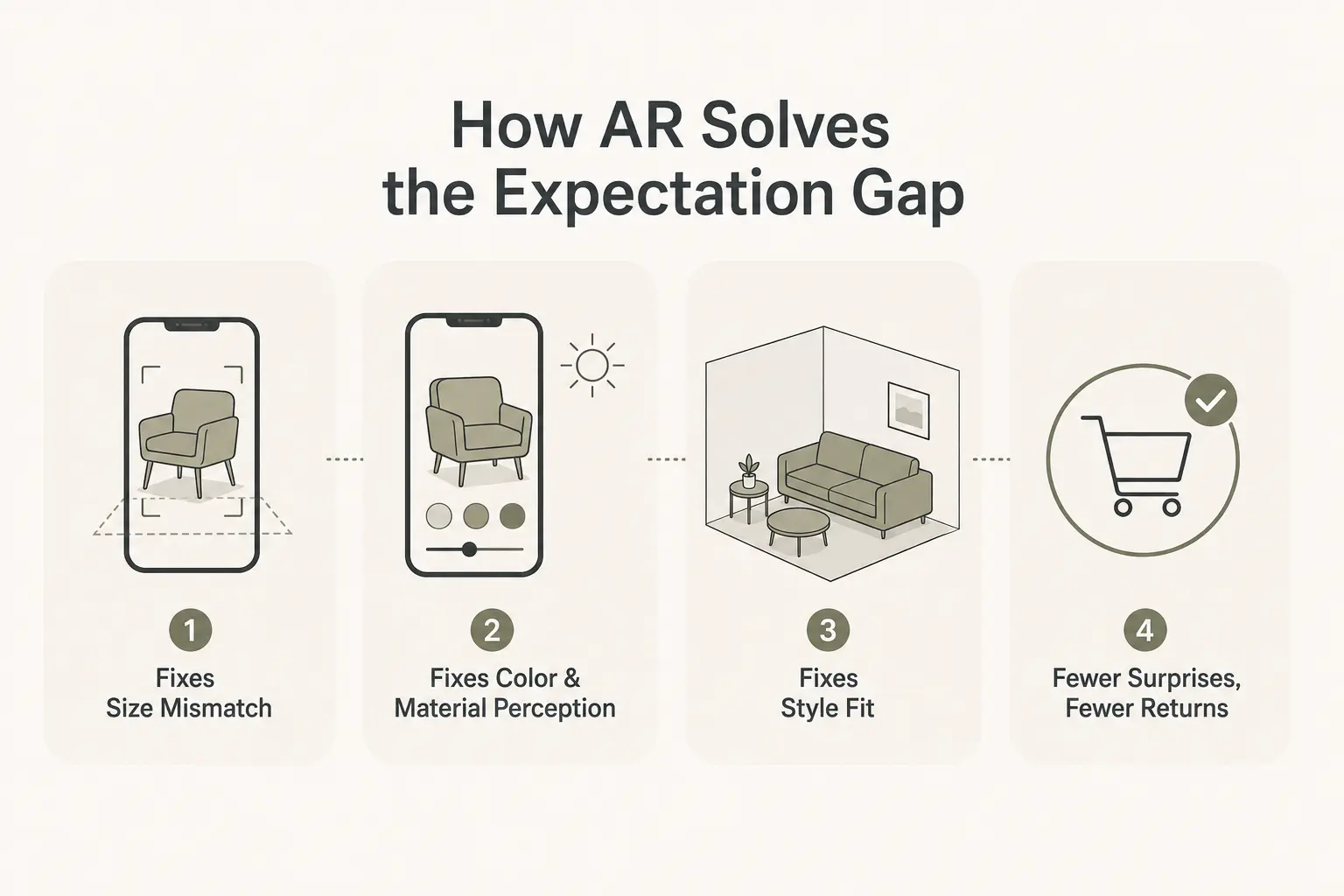
Almost every furniture return traces back to one of three moments of disappointment:
- Size mismatch: “The sofa was 4 inches too wide for the wall.” The dimensions were in the listing. But reading “88 inches” on a product page doesn’t help you visualize it between your bookshelf and your TV stand.
- Color and material perception: Studio photography is shot under controlled lighting. Your living room has warm afternoon light, beige walls, and a terracotta rug. Those two color contexts are nothing alike.
- Style fit: Even if the size was right and the color looked close, “it just didn’t go with our existing furniture.” This is the hardest one to solve with static content alone.
AR directly attacks all three root causes simultaneously, here’s the proof.
How AR Solves the Expectation Gap
What AR Actually Does
Forget the technical jargon for a second. Here’s what a customer experiences:
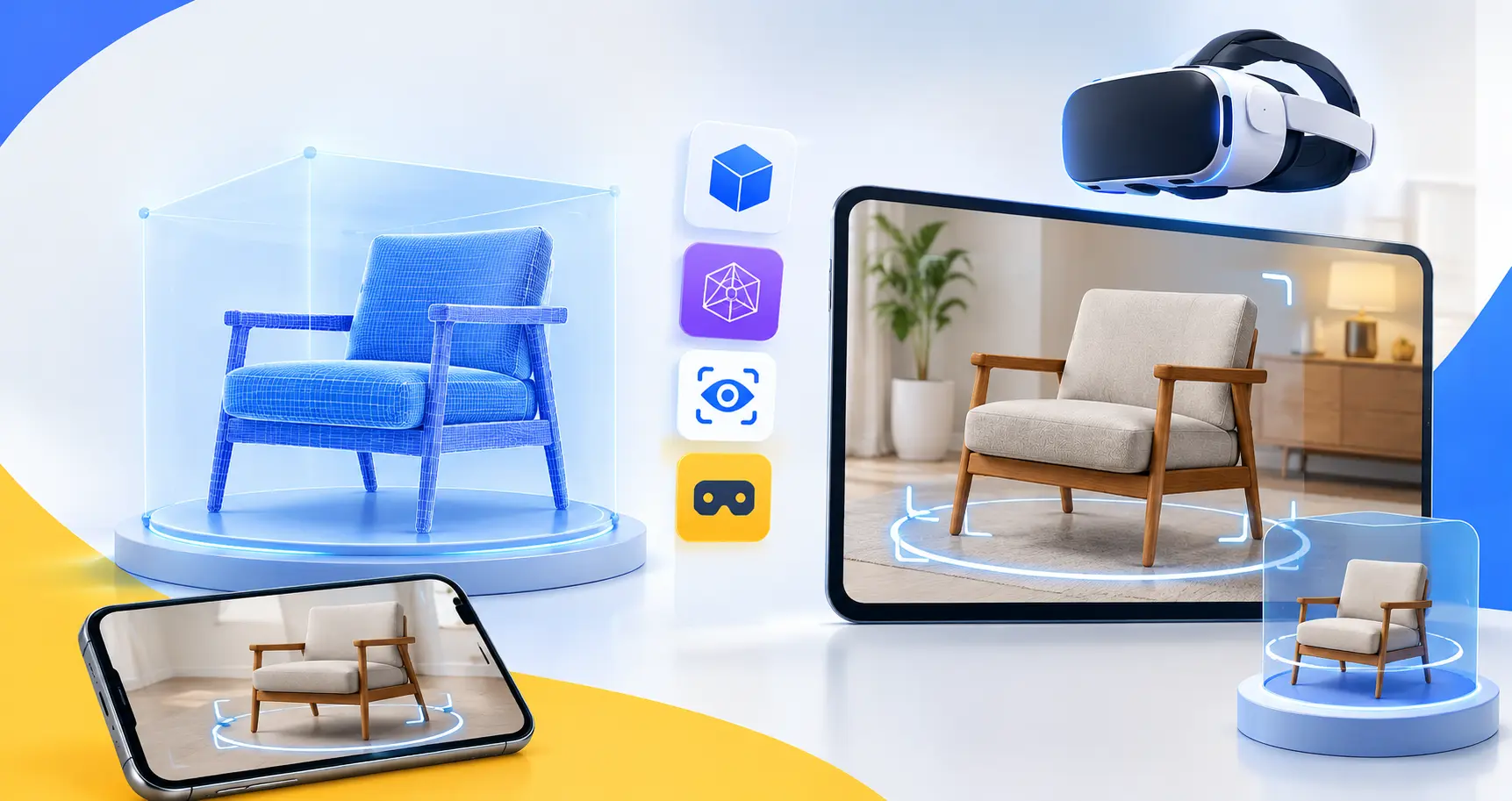
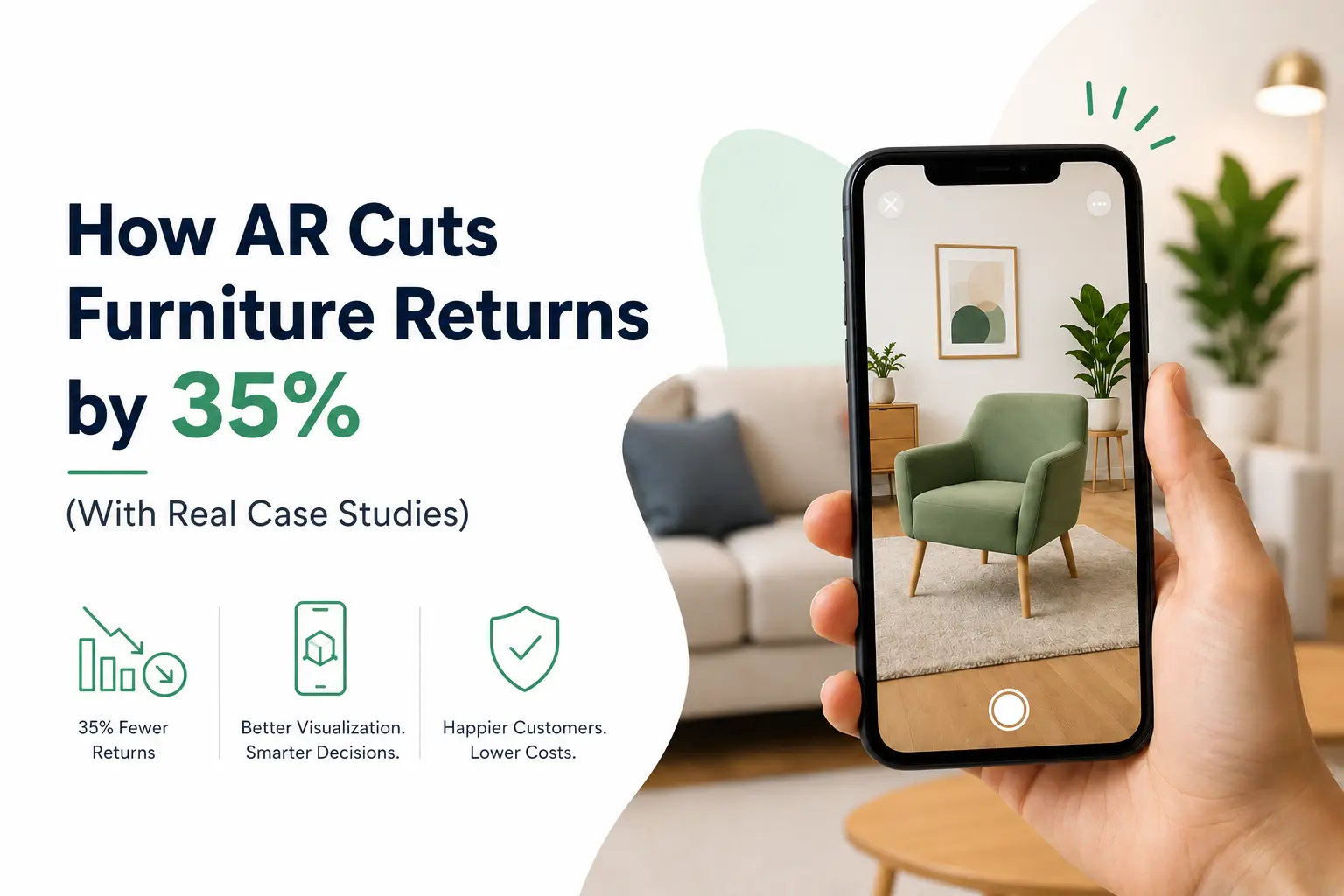
They open their phones. They point it at the corner of their living room. A photorealistic, true-to-scale 3D model of the sofa renders in their space, in their actual lighting, next to their actual furniture. They walk around it.
They swap the color. They add a side table. They take a screenshot to show their partner.
This is not a graphic. Not a mockup. Not a “what it might look like” illustration. It’s a real-time overlay built on their real environment. That’s Augmented Reality, and that’s why it works.
How AR Fixes Size Mismatch
AR renders furniture at exact 1:1 scale. On LiDAR-equipped iPhones and iPads, room scanning takes this further, the device maps walls, floors, and existing furniture, creating a spatial model that catches placement problems before purchase.
This is where Web AR and web-native AR implementations have a distinct advantage: they bring this capability directly to the product detail page (PDP) without requiring any app download, dramatically increasing the number of shoppers who actually engage with the feature.
IKEA Kreativ, for example, evolved beyond simple product placement into full room scanning, building on the legacy of IKEA Place, which set the early standard for AR furniture visualization. You can digitally remove your existing furniture and replace it with an entirely new layout, seeing exactly what fits before you buy a single piece.
How AR Fixes Color and Material Perception
When a 3D model renders in your room via AR, it renders in your room’s ambient lighting. The shadows fall the way your shadows fall. The fabric picks up the warm glow of your lamp. The walnut finish interacts with your flooring tone. This is fundamentally different from studio photography, and it’s why platforms focused on 3D visualization quality, like Threekit and London Dynamics, invest heavily in PBR (physically-based rendering) material fidelity.
How AR Fixes Style Fit
The most powerful AR experiences let customers place multiple pieces simultaneously.
- Wayfair’s 3D Room Planner does exactly this, you’re not just buying a sofa, you’re designing a room.
- Brands like Crate and Barrel and EQ3 have taken a similar approach, using immersive 3D room-building tools to let customers see their full furniture ensemble in context before committing.
Tools like Room View and Wall Art AR, which lets customers preview artwork, mirrors, and décor on their actual walls, apply the same principle to adjacent categories.
- When the customer can see it in context, they return it less.
- For brands exploring third-party routes, platforms like Tangiblee and imagine.io have built AR and Virtual Try-On functionality specifically for home goods and furniture, with eCommerce integrations across Shopify, BigCommerce, and headless storefronts.
It’s also worth noting the role of 360° product viewers here.
- While not full AR, a high-quality 360° product viewer on the PDP is often the stepping stone that primes shoppers to engage with AR when it’s offered.
- Brands that offer both see higher CVR (conversion rate) uplift than those offering either alone.
Think of 360° viewing as the floor and AR as the ceiling, used together, they close the gap on every expectation mismatch.
The Data: AR Reduces Furniture Returns by 35–64% (Cited Sources)
This is the section skeptics need. Let’s look at the actual numbers from actual brands.
Brand / Study | AR Type | Return Rate Impact | Source |
Wayfair | WebAR (“View in Room”) | 35% fewer returns for AR users | Wayfair internal data |
Shopify (merchants) | AR product visualization | 40% fewer returns | Shopify Research |
Macy’s | In-store VR/AR | Dropped to under 2% (from 5–7%) | BrandXR Report, 2025 |
Magna Media Trials | Multi-category AR | 64% reduction in return likelihood | Magna Media Trials study |
A note on methodology: These studies measure different things.
- Some compare AR users vs. non-AR users within the same brand.
- Others are category-wide averages.
That variance matters.
However, the directional consistency across four independent data sources is hard to argue with:
- AR users return furniture significantly less.
This pattern isn’t limited to US retailers:
- UK furniture brand DFS has explored AR visualization.
- AR adoption data from Canada (where furniture e-commerce grew 34% post-pandemic) mirrors US findings.
- Home Depot has also deployed AR for large-item categories, reporting stronger purchase confidence metrics among AR users.
- For brands on BigCommerce, native AR integrations are available through third-party apps that connect directly to product catalogs.
- Google’s investment in ARCore and its Scene Viewer, which enables web-native AR experiences directly in the Google Search results page, has made AR more accessible than ever for eCommerce brands without custom development resources.
The $6.68 billion AR retail market (MarketsandMarkets) isn’t growing because it’s a nice-to-have.
It’s growing because the ROI is real.
Platforms like 1Center and Mazing, both operating in the furniture and home goods AR space, reflect the same market conviction:
- Add-to-cart (ATC) rate lifts
- Conversion rate (CVR) lifts
These results are simply too significant to ignore.
3 Real Case Studies: How Leading Brands Did It
Case Study 1: IKEA, From Product Placement to Full Room Design
Background: IKEA launched IKEA Place in 2017, one of the first major retail AR apps, built on Apple’s ARKit. It accumulated over 8 million downloads. IKEA then built IKEA Kreativ, which added full room scanning and editable 3D room layouts. IKEA Place remains the benchmark case study that other AR furniture deployments are measured against.
Results:
- AR users reported 98% purchase confidence, compared to 85% among non-AR shoppers.
- Customers engaged with AR features 3× more often than with standard product browsing experiences.
- IKEA Kreativ enables complete room makeover planning, creating one of the highest-confidence purchasing journeys in furniture retail.
Key lesson: The progression from “place one product” to “design the whole room” unlocked the biggest confidence gains. More context = more certainty = fewer returns.
Case Study 2: Wayfair, Frictionless WebAR at Scale
Background: Wayfair built “View in Room” on Google ARCore and later expanded to Web AR, meaning customers can access AR directly in their browser with no app download required. This web-native AR approach was a deliberate strategy to increase adoption at the PDP level, rather than requiring a separate app install.
Results:
- AR users were 11× more likely to make a purchase than non-AR users.
- Customers who used AR experienced a 35% lower return rate.
- WebAR achieved wider adoption than app-based AR solutions, helping increase both conversion rate (CVR) and average order value (AOV).
Key lesson: Frictionless access (zero app install) is not just a UX preference, it’s a returns-reduction strategy. More people using AR means more people buying with confidence at scale.
“Augmented reality is the future of how people will shop.”, Steven Conine, Wayfair Co-Founder
Case Study 3: Macy’s, The Most Dramatic Data Point in the Industry
Background: Macy’s deployed VR and AR tools for furniture visualization both in select physical stores and online. The implementation was targeted, not chain-wide, which makes the results even more notable.
Results:
- Under 2% return rate for AR-visualized furniture
- Pre-AR baseline: 5–7%, a 65–71% reduction
- The single largest return rate reduction reported by a major US retailer
Key lesson: You don’t need a full chain rollout to see dramatic results. Even partial, selective deployment of AR drove outsized returns reduction at Macy’s.
Case Study Comparison
Brand | AR Type | Return Rate Before | Return Rate After | Standout Feature |
IKEA | Native App (ARKit) | Not disclosed | 98% purchase confidence | Full room scanning + redesign |
Wayfair | WebAR (ARCore) | Baseline | 35% lower for AR users | No app download required |
Macy’s | VR/AR (in-store + online) | 5–7% | Under 2% | Most dramatic % drop |
What do IKEA, Wayfair, and Macy’s have in common? They all started small and scaled. Brands like Crate and Barrel and EQ3 have followed a similar trajectory, beginning with 3D models on select high-return SKUs, then expanding AR furniture coverage as the ROI became undeniable. Here’s how to calculate your ROI before you build.
The ROI Calculator: What 35% Fewer Returns Means for Your Brand
The Returns Cost Formula
Annual Returns Cost = Revenue × Return Rate × Processing Cost %
Example: $5M revenue, 18% return rate, 40% processing cost = $360,000/year in returns losses.
Scenario | Without AR | With AR (35% reduction) |
Annual returns cost | $360,000 | $234,000 |
Annual savings | — | $126,000 |
AR implementation cost (WebAR) | — | $15,000–$40,000 |
Estimated payback period | — | 1.5–4 months |
Additional Revenue Upside (Not Just Returns)
The returns savings are the headline, but the CVR and AOV impact is equally significant:
- +40% CVR (conversion rate) lift for AR-enabled product pages (Shopify Research)
- 11x purchase likelihood for Wayfair AR users
- Higher AOV as purchase confidence increases, confident shoppers are more likely to add coordinating pieces
- Meaningful lift in ATC (add-to-cart) rate, with My AR Studio and Mazing both reporting ATC improvements of 20–40% for AR-enabled products in furniture categories
To calculate your exact returns savings, use Orb3D’s AR ROI Calculator, built specifically for furniture and home goods brands.
Read more : 3D Furniture Modeling Costs in 2026:Hidden cost & Scaling Guide
Implementation Roadmap: 4 Ways to Add AR to Your Furniture Store
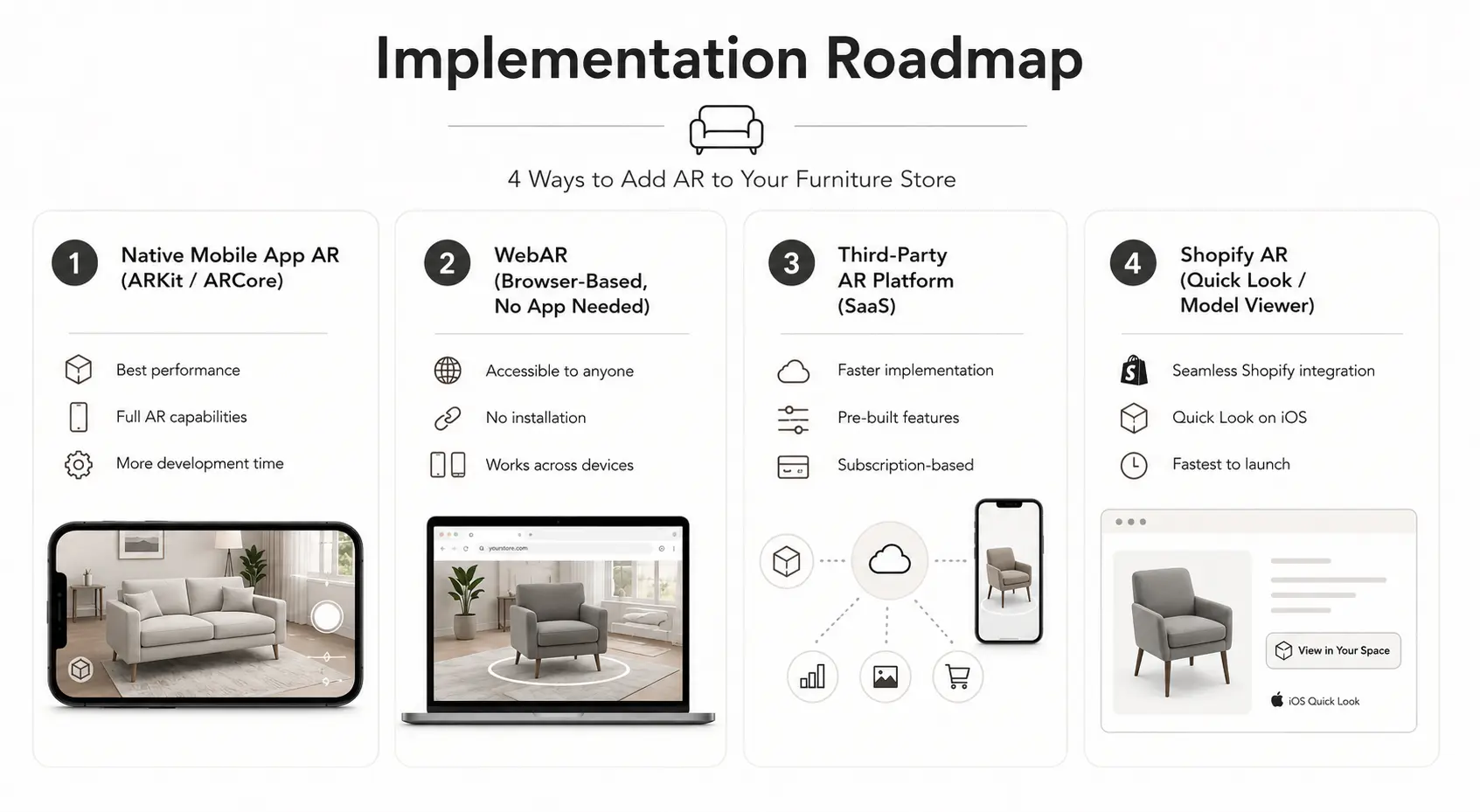
Option 1: Native Mobile App AR (ARKit / ARCore)
Best for: Established brands with large budgets and existing app infrastructure.
- Timeline: 12–24 weeks
- Cost: $50,000+
- Examples: IKEA Place, Houzz AR
- Pros: Best possible AR experience, full LiDAR room scanning
- Cons: App download friction reduces adoption
Option 2: WebAR (Browser-Based, No App Needed)
Best for: Mid-size DTC brands who want broad reach without app friction.
- Timeline: 4–8 weeks (with existing 3D model library)
- Cost: $10,000–$40,000
- Examples: Wayfair “View in Room”, My AR Studio for furniture eCommerce
- Pros: Zero friction, customers click and try at the PDP, no install required. Web AR and web-native AR implementations also benefit from Google’s Scene Viewer, which surfaces 3D models directly in Google Search
- Cons: Slightly lower fidelity on older devices
This is the format Orb3D specializes in for furniture brands that want to move fast without sacrificing quality.
Option 3: Third-Party AR Platform (SaaS)
Best for: SMBs and brands with limited dev resources, including those on Shopify, BigCommerce, or headless storefronts.
- Timeline: 2–4 weeks
- Cost: $500–$3,000/month
- Examples: imagine.io, Tangiblee, Cylindo, Zakeke, Cappasity, Threekit, 1Center, Mazing, London Dynamics
- Pros: Fast to launch, often includes 3D model library, lower barrier to proving ROI
- Cons: Less customization, ongoing SaaS cost
imagine.io and Tangiblee are worth noting specifically, both have furniture-focused AR pipelines and integrate with major eCommerce platforms including Shopify and BigCommerce. Threekit stands out for enterprise-grade 3D visualization and configurator capabilities, while London Dynamics brings deep 3D models expertise to the mid-market segment. Mazing and 1Center are emerging players focused specifically on the AR furniture and home goods vertical, offering streamlined onboarding for eCommerce brands.
Option 4: Shopify AR (Quick Look / Model Viewer)
Best for: Shopify-native stores looking for the quickest path to AR.
- Timeline: 1–2 weeks per product
- Cost: $2,000–$10,000 for 3D model creation
- Format: USDZ (iOS) / GLB (Android)
- Results: Shopify reports 94% higher CVR for products with AR
Read more : How to Add 3D Furniture Models to Shopify Stores (No Code need): Step-by-Step Process
Which AR Option Is Right for You?
Budget | Timeline Need | Tech Capacity | Recommended Option |
$500–$3K/month | Fast (2–4 weeks) | Low | SaaS platform (Cylindo, Zakeke, Mazing, 1Center) |
$5K–$40K total | Moderate (4–8 weeks) | Medium | WebAR (Orb3D, My AR Studio, custom Web AR) |
$10K+ total | Flexible | Shopify store | Shopify AR (Quick Look) |
$50K+ total | 3–6 months | High | Native app (ARKit/ARCore) |
The 3D Model Quality Imperative
Your AR is only as good as your 3D models.
Low-quality 3D models with incorrect proportions, flat textures, or poor material rendering don’t just fail to reduce returns, they can increase them by misleading customers in a new direction.
The minimum standard for furniture AR today:
- Photorealistic USDZ / GLB format, 3D models exported to web-compatible formats
- Accurate dimensions (within millimeters)
- PBR (physically-based rendering) materials that respond to lighting
- Texture resolution sufficient for close-up inspection
At Orb3D, every 3D model goes through a quality review before it goes live, because a bad model is a liability, not an asset. Providers like Threekit, My AR Studio, and London Dynamics apply similar quality gates in their pipelines, which is part of why dedicated AR furniture platforms often outperform generic 3D visualization tools when it comes to real-world returns impact.
Common Objections (And What the Data Says)
“AR is too expensive for small brands.”
Web AR SaaS starts at $500/month. Based on the returns math above, a brand doing $1M/year with an 18% return rate saves roughly $25,200/year with a 35% reduction, payback in under 3 months. Tools from Mazing, 1Center, and My AR Studio have further compressed the cost of entry for AR furniture visualization.
“Our customers won’t use it.”
- 61% of online shoppers say they prefer AR-enabled retailers (Deloitte/Snap Consumer AR Report)
- 71% say they shop more frequently at AR-enabled stores
- Among shoppers under 35, Augmented Reality is increasingly expected, not exceptional
“3D models are too expensive to create.”
Costs have fallen dramatically. In 2019, a photorealistic furniture model cost $500–$2,000. Today, batch creation runs $50–$200 per SKU. Costs have dropped roughly 80% in five years.
Platforms like London Dynamics and Threekit now offer automated 3D model generation pipelines that can process entire product catalogs in a fraction of the time manual modeling previously required.
“AR accuracy isn’t good enough.”
LiDAR-equipped devices (iPhone 12 Pro and later, iPad Pro) offer millimeter-accurate room scanning. Even standard Web AR without LiDAR is accurate enough to solve size mismatch decisions, the #1 driver of furniture returns. Accuracy objections were valid in 2019. They aren’t in 2025.
What’s Next: AI + AR and Spatial Commerce
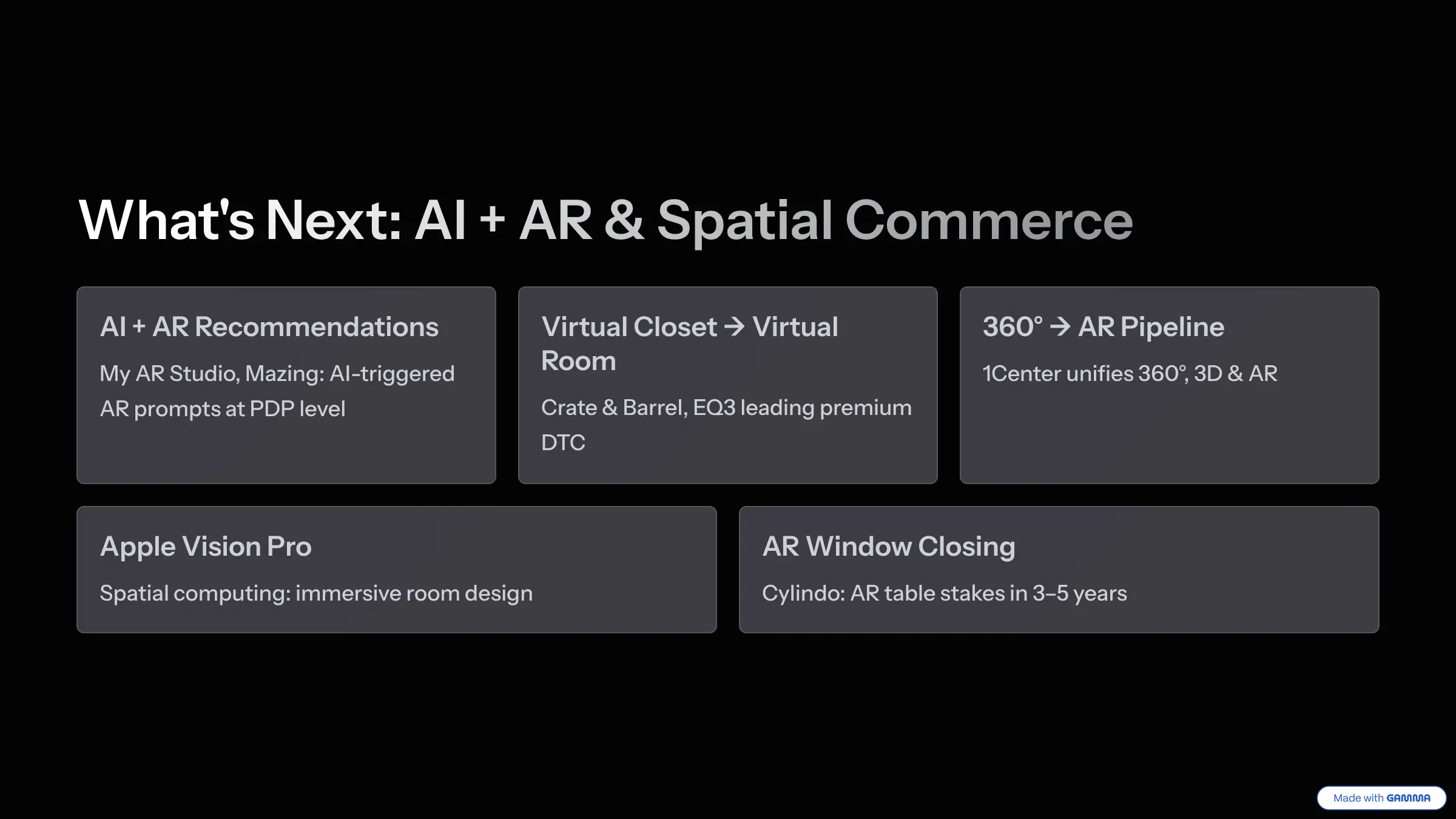
AI-powered style recommendations + AR visualization: Imagine a system that knows your room’s color palette and recommends furniture that already matches, which you can then place in your room via AR before buying. Platforms like My AR Studio and Mazing are already using AI data analysis to identify high-return SKUs and proactively trigger AR prompts for exactly those products at the PDP level.
Virtual Closet meets Virtual Room: The same logic that made Virtual Try-On mainstream in fashion, pioneered by brands like Warby Parker and adopted across apparel, is now being applied to home interiors. Furniture brands in cities like Chicago with dense urban apartments are seeing especially strong AR adoption and returns impact. Brands like Crate and Barrel and EQ3 are leading this transition for premium DTC furniture in North America.
The 360° product viewer to AR pipeline: The next generation of eCommerce PDPs will likely blend 360° product viewer spins, 3D visualization, and full Augmented Reality into a seamless, unified product experience. Platforms like 1Center are already building toward this, offering all three modalities under one integration.
Apple Vision Pro and spatial computing: Full room design as an immersive experience, not a phone overlay, but a spatial environment you walk through. VR and AR are converging toward a unified spatial commerce layer, and early movers in AR furniture will have the 3D models, the data pipelines, and the consumer trust to lead in that environment too.
The AR adoption window: Cylindo’s industry research has flagged this directly, AR is still a differentiator, but the window is closing. Within 3–5 years, AR product visualization may be table stakes, not a standout feature. The brands investing in Augmented Reality infrastructure today, 3D models, Web AR capabilities, PDP integrations, are building competitive moats that will only compound over time.
FAQ
Q: Does AR really reduce furniture returns?
Yes. Studies from Wayfair, Shopify, Macy’s, and Magna Media Trials show return rate reductions of 35–64% for customers who use AR before purchasing.
Q: How much does furniture AR cost?
Furniture AR costs range from $500/month for SaaS platforms to $50,000+ for custom native apps. Most DTC brands start with WebAR solutions costing $10,000–$25,000.
Q: Which furniture brands use AR?
Brands using AR include IKEA, Wayfair, Macy’s, Ashley Furniture, Houzz, Home Depot, DFS, Crate and Barrel, EQ3, and Amazon.
Q: What is the average furniture return rate?
Furniture eCommerce return rates typically range from 15–20%, with some DTC brands reporting rates as high as 30%.
Q: How does IKEA Place reduce returns?
IKEA Place allows customers to place true-to-scale 3D furniture models in their real space, helping solve size, color, and style-fit issues before purchase.
Conclusion
The math is not subtle. Furniture returns are a $362 billion industry-wide problem. The three causes, size mismatch, color perception, and style fit, are predictable and solvable. And AR solves all three simultaneously with documented, consistent results: 35–64% return rate reductions across IKEA, Wayfair, Macy’s, and broader Shopify and Magna Media research.
The competitive landscape is no longer hypothetical. Threekit, London Dynamics, Mazing, My AR Studio, and 1Center are all investing heavily in AR furniture infrastructure. Crate and Barrel and EQ3 are already reaping the returns benefits.
Google has embedded Augmented Reality into the core commerce discovery layer via Search. The infrastructure is in place. The CVR and AOV data is in. The brands moving now are building moats. The brands waiting are paying for returns that didn’t have to happen.
Start a free trial and see how photorealistic 3D models and WebAR can help reduce returns, increase purchase confidence, and improve conversion rates across your product catalog.