When I first started helping furniture brands create online catalogs and marketing visuals, I noticed a common challenge: traditional photography was slow, expensive, and inconsistent. Chairs, sofas, and office furniture often require multiple angles, color variations, and lifestyle scenes, which quickly drive up costs.
That’s when I saw the power of 3D furniture rendering. It allows brands to produce high-quality, realistic visuals without relying on photoshoots, while speeding up product launches and keeping catalog content consistent. In this guide, I’ll walk you through the costs, challenges, and practical benefits of chair, sofa, and office furniture rendering in 2026 so you can make informed decisions for your brand.
What Is Furniture Rendering?
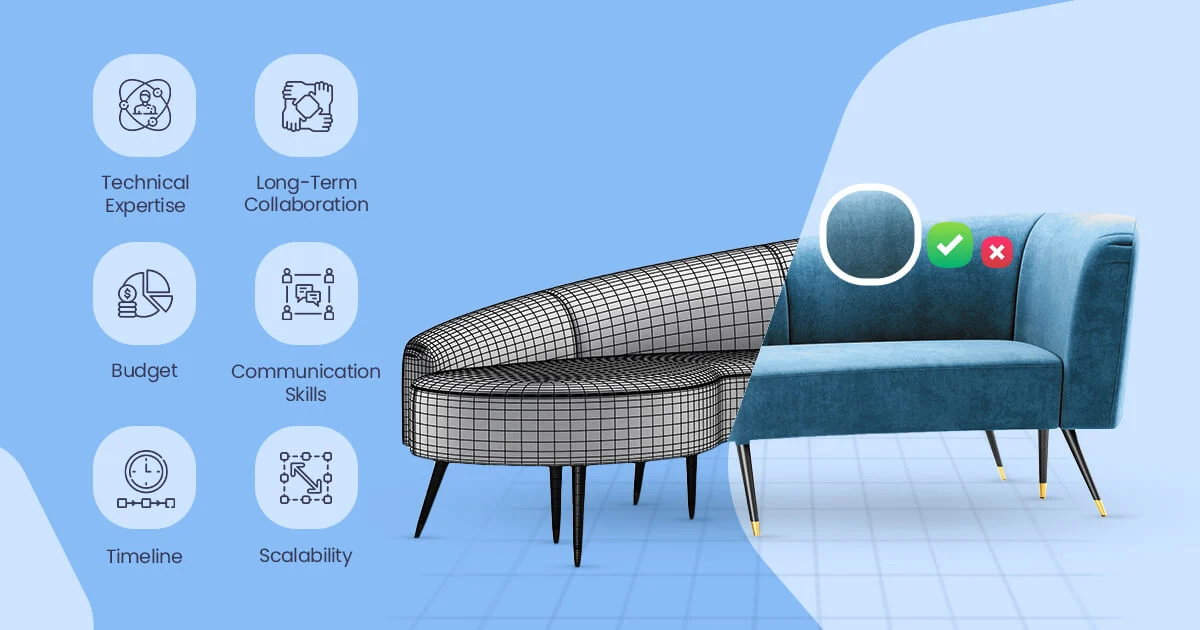
Furniture rendering is the process of creating realistic digital images of furniture using 3D technology instead of photographing physical products. Brands use these renders to show chairs, sofas, and office furniture accurately across e-commerce stores, catalogs, and marketing materials-often before the product is manufactured.
In simple terms, furniture rendering replaces or reduces traditional photoshoots while giving brands more control, speed, and consistency.
How 3D Furniture Rendering Works for Furniture Brands
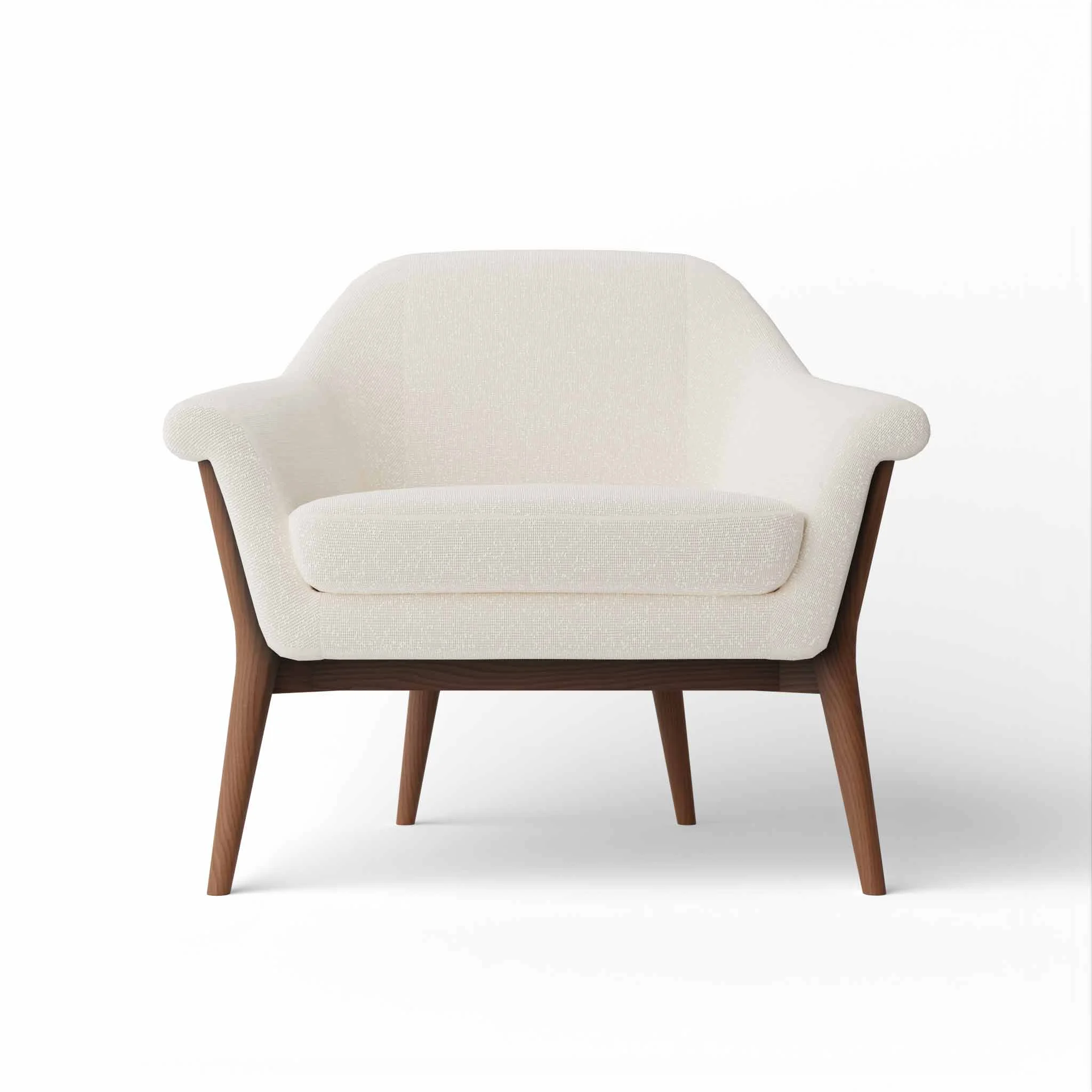
What is 3D furniture rendering? It starts with a digital furniture model built from CAD files, technical drawings, or reference images. Materials, lighting, and camera angles are then applied to produce images that closely match real-life furniture.
Why brands use it instead of photoshoots Furniture brands choose rendering because it:
- Eliminates repeated photoshoot costs
- Allows unlimited color, fabric, and finish variations
- Enables faster product launches
- Keeps visuals consistent across large catalogs
For brands managing multiple SKUs, rendering is often more scalable and cost-efficient than photography.
Common Types of Furniture Renders Buyers Use
Product (white background) renders
Clean, isolated images used for e-commerce listings, marketplaces, and catalogs. These focus on clarity, proportions, and details.
Lifestyle/interior scene renders
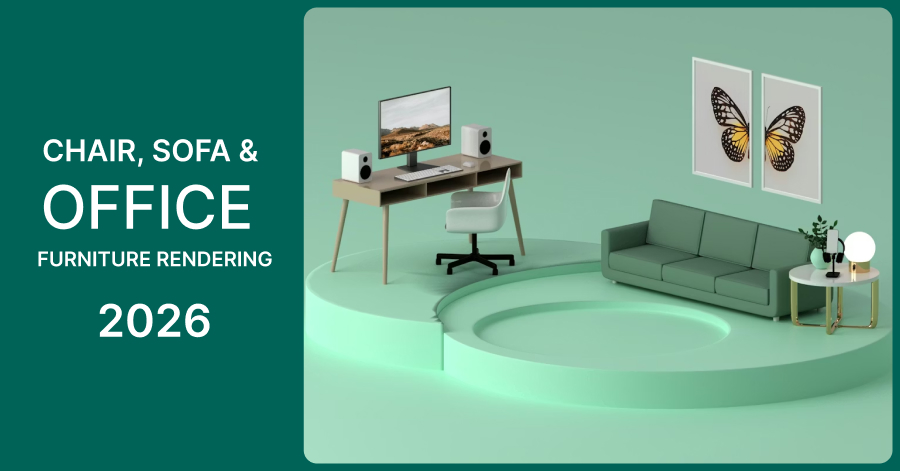
Furniture placed in realistic room settings to show scale, context, and design appeal. Commonly used for websites, ads, and brand storytelling.
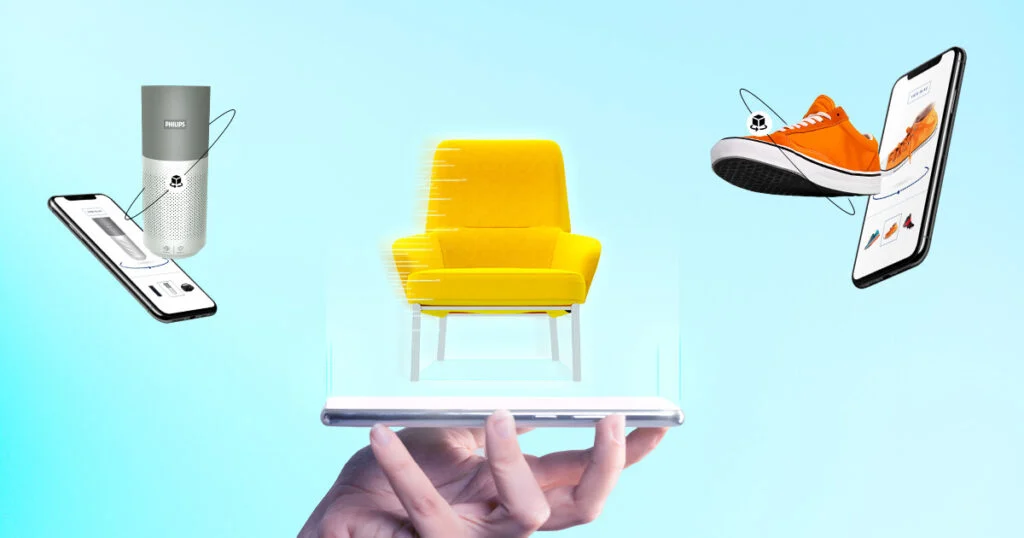
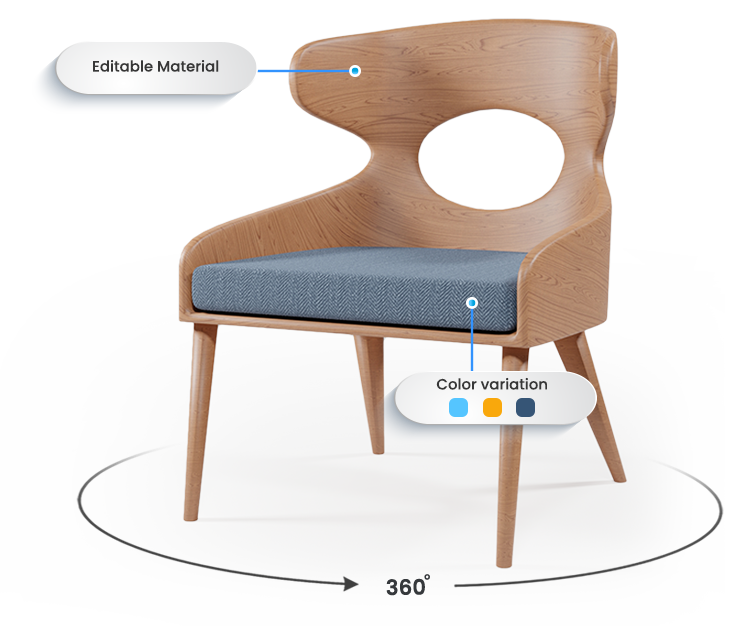
360° & AR-ready renders
Interactive visuals that allow buyers to rotate products or view them in their own space using AR. These are increasingly used to improve buyer confidence and reduce return
Chair, Sofa & Office Furniture Rendering-Differences That Affect Cost
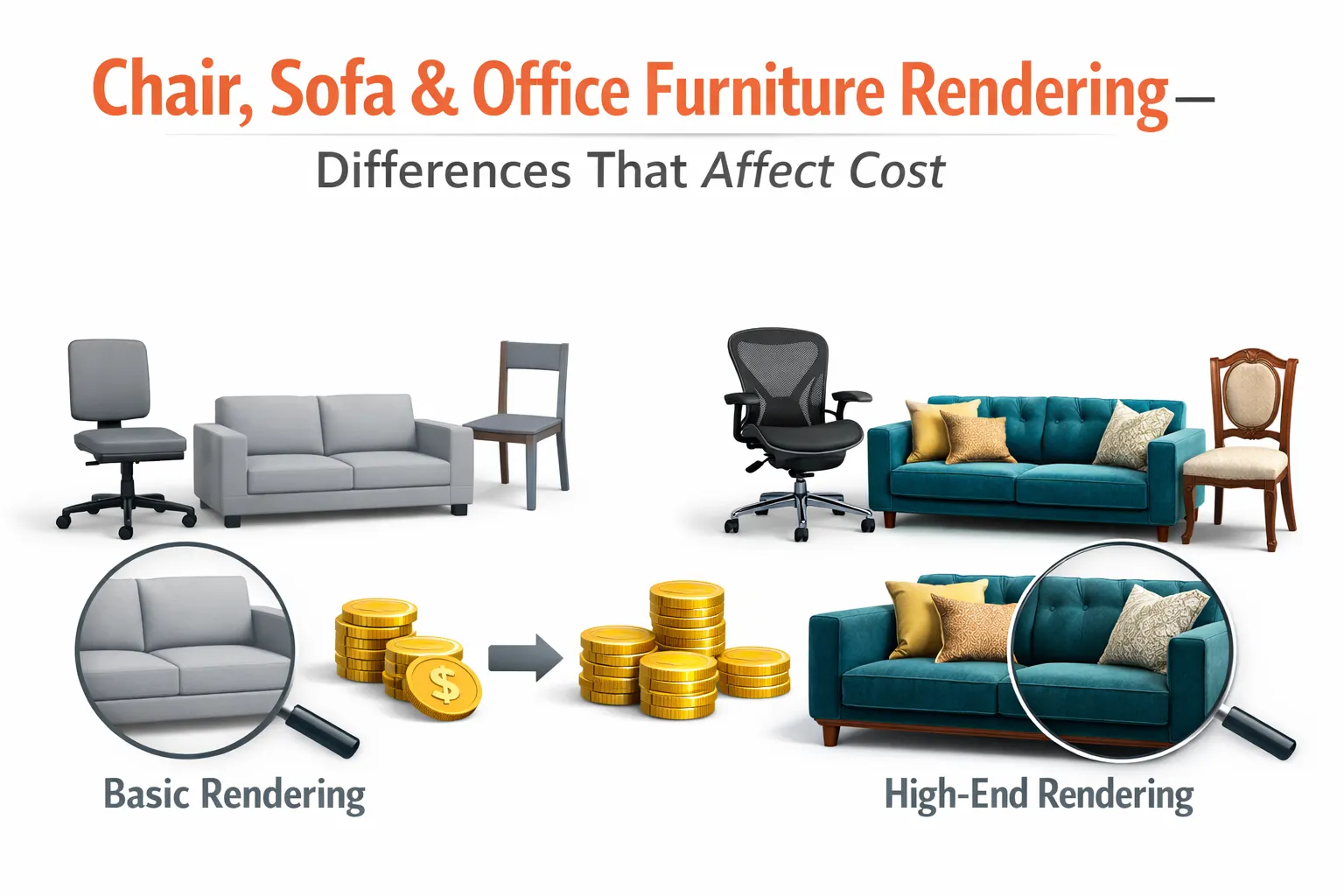
Average Furniture Rendering Costs in 2026 (Quick Comparison)
Furniture Type | Typical Use Case | Avg Cost per Image (USD) | Why Cost Varies |
Chair Rendering | E-commerce, catalogs, marketplaces | $40–$70 | Simple geometry, fewer materials, easy variations |
Sofa Rendering | Marketing visuals, lifestyle scenes | $90–$180 | Fabric folds, cushions, texture realism |
Office Furniture Rendering | B2B catalogs, commercial proposals | $120 – $250+ | Modular systems, strict dimensional accuracy |
Lifestyle/Interior Scene | Branding, ads, hero images | $120 – $250+ | Scene setup, lighting, environment modeling |
360°/AR-Ready Assets | Interactive e-commerce, AR viewers | $200 – $500+ | Multiple angles, optimization for interaction |
Furniture Rendering vs Photoshoot Cost Comparison
Cost Factor | 3D Furniture Rendering | Traditional Photoshoot |
Upfront Cost | Medium | High |
Cost per Color/Variant | Very low | High (new shoot needed) |
Scalability | High (reuse models) | Low |
Time to Market | Fast | Slow |
Long-Term Cost | Lower | Higher |
Chair Rendering for E-commerce & Catalogs
Why chairs are cheaper to render:
Chairs usually have
- Simpler geometry
- Fewer materials and parts
- Minimal fabric deformation
Because of this, chair models take less time to build and render, making them the most cost-effective furniture items for 3D visualization.
ROI for high-volume SKUs
Chair rendering delivers strong ROI for brands with:
- Multiple color or finish variations
- Large online catalogs
- Marketplace listings
One chair model can be reused across dozens of variations, reducing per-image costs dramatically compared to repeated photoshoots.
Sofa Rendering for Marketing & Lifestyle Use
Fabric complexity
Sofas involve:
- Soft cushions and organic shapes
- Fabric folds, wrinkles, and stitching
- Multiple upholstery materials
These details require advanced modeling and texturing, which increases production time.
Why sofas cost more:
Sofa rendering is more expensive because:
- Material realism is critical
- Lifestyle scenes are often required
- Buyers expect close-up detail accuracy
Higher cost is justified by stronger visual impact and better performance in marketing campaigns.
Office Furniture Rendering for B2B & Commercial Projects
Modular systems
Office furniture often includes:
- Workstations and panels
- Storage and cable systems
- Configurable layouts
Each component must align precisely, increasing modeling complexity.
Why office furniture has higher pricing:
Office furniture rendering costs more due to:
- Strict dimensional accuracy requirements
- B2B decision-maker expectations
- Use in tenders, catalogs, and space planning
In commercial projects, accuracy and clarity matter more than aesthetics, making office furniture one of the highest-priced rendering categories.
Challenges in Chair, Sofa & Office Furniture Rendering
Common Furniture Rendering Challenges Brands Face
Mismatch with the real product
One of the most common buyer complaints is that the final render doesn’t fully match the manufactured furniture. This usually happens due to incomplete CAD files, last-minute design changes, or unclear material references.
Inconsistent quality across products
When multiple items are rendered separately or by different teams, lighting, scale, and texture quality can vary-making catalogs look unprofessional and reducing brand trust.
Unexpected revisions and added costs
Vague briefs and late feedback often lead to extra revisions. Each revision adds time and increases overall project cost.
Why Sofa & Office Furniture Are Harder to Render
Sofa fabric realism
Sofas are challenging because they involve:
- Soft cushions and organic shapes
- Fabric folds, wrinkles, and stitching
- Multiple upholstery materials
Even small errors in fabric behavior can make a sofa render look artificial.
Office furniture accuracy issues
Office furniture rendering focuses heavily on:
- Exact dimensions
- Modular alignment
- Functional clarity
B2B buyers rely on accuracy more than aesthetics, so precision errors are more noticeable and costly.
Accuracy & Realism Problems
Material matching issues
Incorrect texture scale, roughness, or reflectivity can cause wood, fabric, or metal surfaces to look unrealistic.
Scale & proportion errors
Without correct measurements or reference objects, furniture can appear too large, too small, or visually distorted-especially in lifestyle scenes.
Why some renders look fake
Common reasons include:
- Over-perfect surfaces with no imperfections
- Unrealistic lighting and shadows
- Low-quality textures
Realism depends on subtle detail, not excessive sharpness.
Technical & Production Challenges
Poor CAD files
Incomplete or outdated CAD files increase modeling time and often require manual rebuilding, which raises cost and risk.
Workflow delays
Delays usually come from:
- Late design changes
- Unclear feedback cycles
- No defined approval process
How to Avoid Costly Rework
Clear specifications
Finalize dimensions, materials, and finishes before rendering begins.
Test renders
Approving an early test render helps catch errors before full production.
Approval stages
Using defined approval checkpoints prevents repeated revisions and keeps projects on schedule.
AI vs 3D Furniture Rendering in 2026
Can AI-Generated Furniture Images Be Used for Real Products?
Accuracy risks
AI-generated furniture visuals often invent details that don’t exist, such as incorrect proportions, unrealistic textures, or impossible designs. This makes them unreliable for product-accurate marketing.
Ecommerce problems
Using AI images for online stores can lead to:
- Misleading product representations
- Increased customer returns
- Marketplace compliance issues
For brands that sell online, AI images cannot replace real renders when accuracy matters.
AI vs Traditional 3D Rendering – What Brands Should Choose
Control
3D rendering provides full control over angles, lighting, materials, and variations. AI offers speed but very limited customization.
Accuracy:
Traditional 3D models are based on actual CAD files or design specifications, ensuring exact proportions and realistic materials. AI cannot guarantee this level of precision.
Brand safety:
With 3D rendering, brands maintain consistency across catalogs and avoid misleading visuals. AI imagery may produce inconsistent results that confuse customers and harm trust.
In short:
- Use 3D rendering for all product-accurate, e-commerce, and B2B visuals.
- AI can be used only for concept sketches or early design ideation, not final product listings
Ecommerce & Conversion Impact of Furniture Rendering
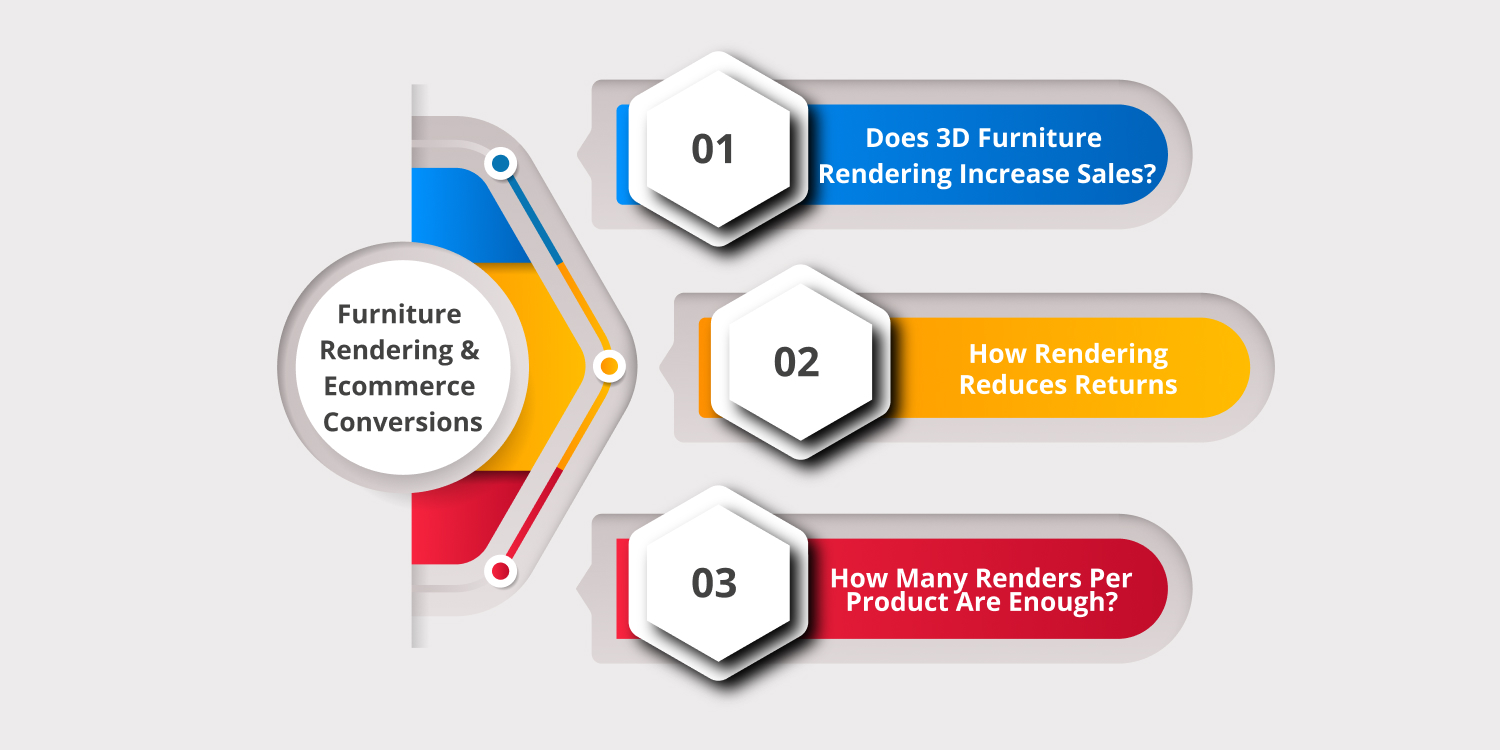
Ever wondered if 3D furniture renders really boost online sales? From experience, they absolutely do-and here’s why.
1. Does 3D furniture rendering actually increase sales?
Realistic 3D images can convince buyers faster. Shoppers tend to spend more time engaging with products that have clear, photorealistic renders. They can zoom in, check textures, and understand the shape instantly, which reduces uncertainty.
A good render also reduces hesitation at checkout. Buyers gain confidence because they don’t have to guess about color, fabric, or size-they see the product exactly as it is. For high-ticket items like sofas or office systems, this confidence can directly turn browsers into buyers.
Lifestyle images are also important for conversions. Showing at least one lifestyle scene per product helps buyers visualize how the furniture fits into a room and makes the product feel more tangible, even online.
2. How does furniture rendering reduce returns?
Accurate scale in renders prevents mismatched expectations. Many returns happen because chairs look smaller than expected or a sofa doesn’t fit the space. True-to-life dimensions in 3D renders ensure buyers know exactly what they’re getting.
Realistic material textures matter too. Capturing fabric weave, leather sheen, or wood grain reassures buyers that the product will look as advertised, reducing complaints and returns.
Showing all color variations and finishes is essential. A single 3D model can generate multiple options, keeping visuals consistent and avoiding surprises that might lead to returns.
3. How many renders per product are enough?
For most products, 4–6 high-quality images are sufficient:
- 3–4 images from key angles (front, side, back, top)
- 1 close-up showing material or texture details
- 1 lifestyle shot for context
Interactive 360° or AR views are optional but valuable for high-value or customizable items. They let buyers rotate the furniture or place it virtually in their own space, increasing confidence and conversions. For smaller or standard products, these are less critical.
Too many images can overwhelm buyers. More than 10–12 unnecessary pictures can slow page load and decision-making. Focus on quality visuals rather than quantity.
4. What about ROI?
When I compare the cost of rendering versus traditional photography:
- Renders are reusable: one model generates multiple colors, finishes, and angles.
- No shipping or staging costs: unlike physical photoshoots, I don’t have to move heavy furniture around.
- Faster time-to-market: new products can go live online immediately, sometimes even before manufacturing is finished.
All of this means that, in my experience, the initial investment in rendering pays off quickly through higher sales, fewer returns, and lower ongoing visual content costs.
Bottom Line
If I were running an e-commerce furniture brand in 2026, I’d make 3D furniture rendering a core part of my strategy. It:
- Boosts conversions by showing products clearly
- Reduces returns through realistic scale and material visualization
- Saves costs compared to repeated photoshoots
- Scales easily for multiple SKUs
High-quality 3D renders aren’t just “nice-to-have”-they’re a practical tool that directly impacts revenue and customer trust
Frequently Asked Questions About Chair, Sofa & Office Furniture Rendering:
1. What is chair, sofa, and office furniture rendering?
It is the process of creating realistic digital images of furniture using 3D modeling instead of traditional photography for e-commerce, catalogs, and marketing.
2. How does 3D furniture rendering work?
It uses CAD files or references to build a 3D model, apply materials and lighting, and generate photorealistic images.
3. Is 3D furniture rendering better than photography?
Yes, it offers faster production, lower long-term costs, and consistent visuals with unlimited variations.
4. How much does furniture rendering cost in 2026?
Chair rendering costs $40–$70, sofa rendering $90–$180, and office furniture rendering $120–$250+ per image.
5. Why is sofa rendering more expensive?
Because realistic fabric folds, textures, and cushioning require advanced modeling and detailing.
6. Why is office furniture rendering more complex?
It requires strict dimensional accuracy and modular alignment for B2B and commercial use.
7. What are the main challenges in furniture rendering?
Product mismatches, inconsistent quality, and extra costs from revisions.
8. Can AI replace 3D furniture rendering?
No, AI lacks accuracy and cannot reliably represent real furniture products.
9. How many renders are ideal for e-commerce?
Usually 4–6 high-quality images per product.
10. Does 3D furniture rendering improve sales?
Yes, it increases buyer confidence, boosts conversions, and reduces returns.
Conclusion
After working with multiple furniture brands, I can confidently say that 3D furniture rendering is more than just a nice-to-have. It reduces costs, improves accuracy, boosts online conversions, and ensures your visuals scale with your catalog.
Chairs are typically the most cost-effective to render, sofas require more detail and investment, and office furniture demands high precision for B2B buyers. Rendering is especially valuable for brands with multiple SKUs or those selling online, while single handmade or low-volume items may still benefit from traditional photography.
Ultimately, investing in furniture rendering in 2026 means faster product launches, more consistent visuals, fewer returns, and happier customers. For any furniture brand serious about e-commerce, it’s a tool that pays for itself quickly and supports long-term growth.
If you want to render your sofa or furniture, there’s no need to pay-just start a free trial and see the magic!