
Traditional furniture photoshoots are expensive, slow, and impossible to scale. A single shoot for five SKUs can run $3,000 or more – and the moment you add a color variant or a new fabric, you’re back to square one.
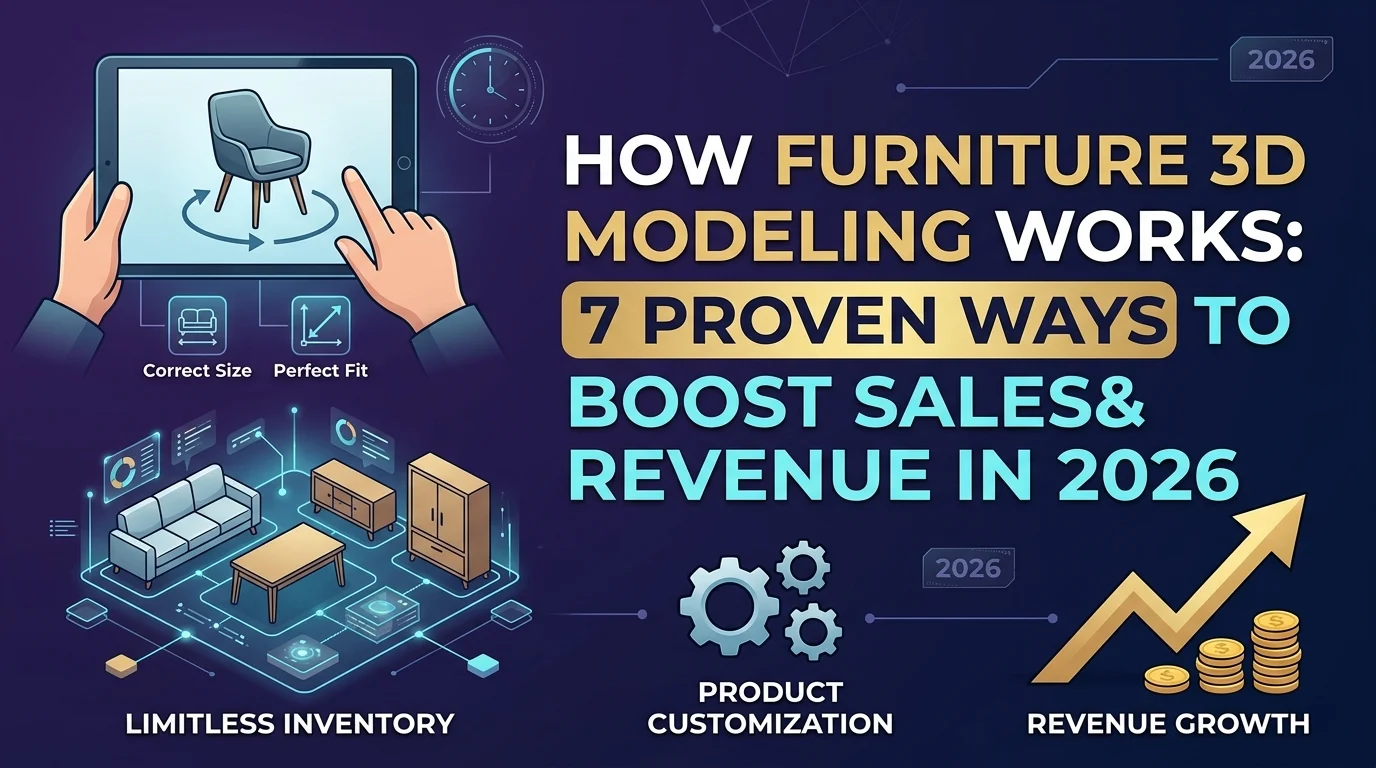
After working with furniture brands on 3D visualization workflows, one thing becomes clear fast: furniture 3D modeling is not just a content tool. It is a revenue strategy. The brands winning online in 2026 are the ones who understand this.
In this guide, you will solve the high cost and low conversion problem of traditional product content with:
- A side-by-side comparison of 3D modeling vs. traditional photography
- 7 proven, data-backed ways 3D modeling directly grows your furniture business
- Real industry insights and research that prove why this shift is happening now
Built from furniture industry benchmarks, Shopify e-commerce data, and 3D visualization studio research – this is practical advice, not theory.
What Is Furniture 3D Modeling?
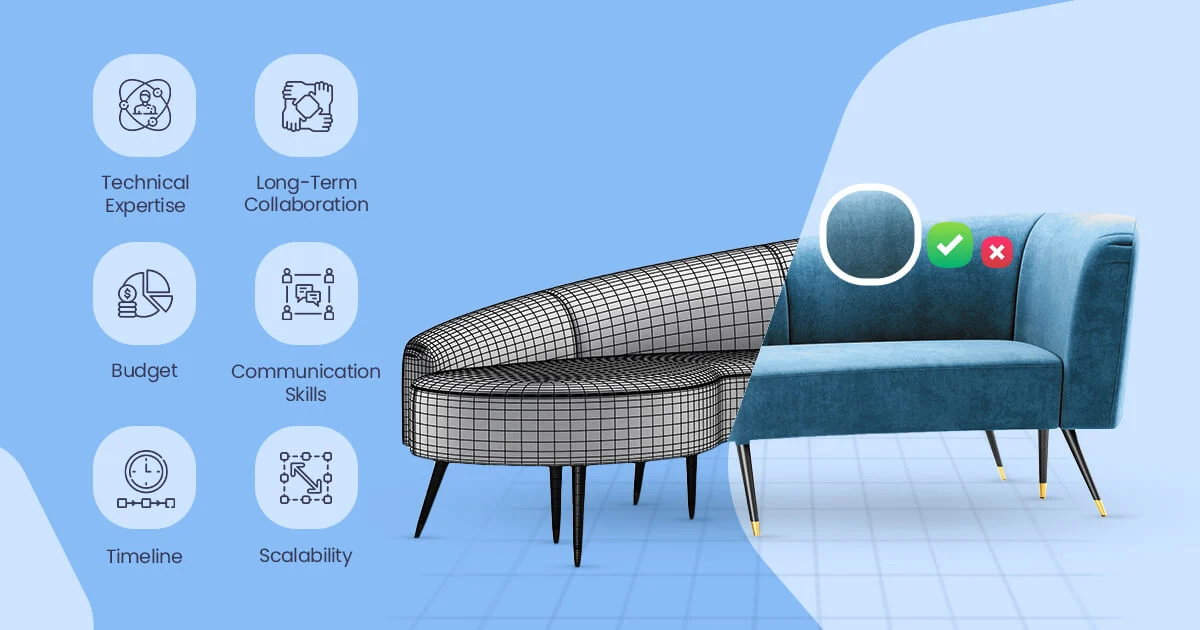
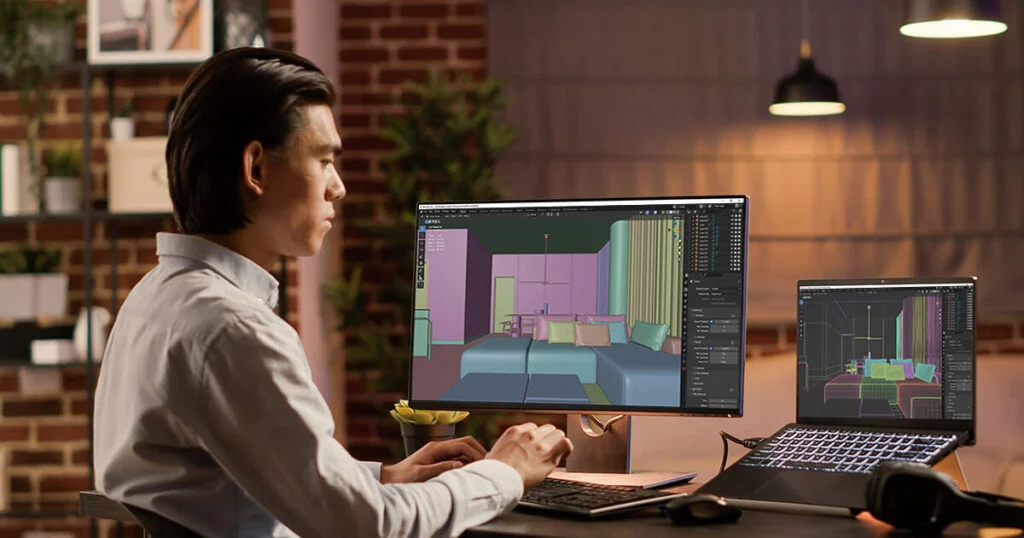
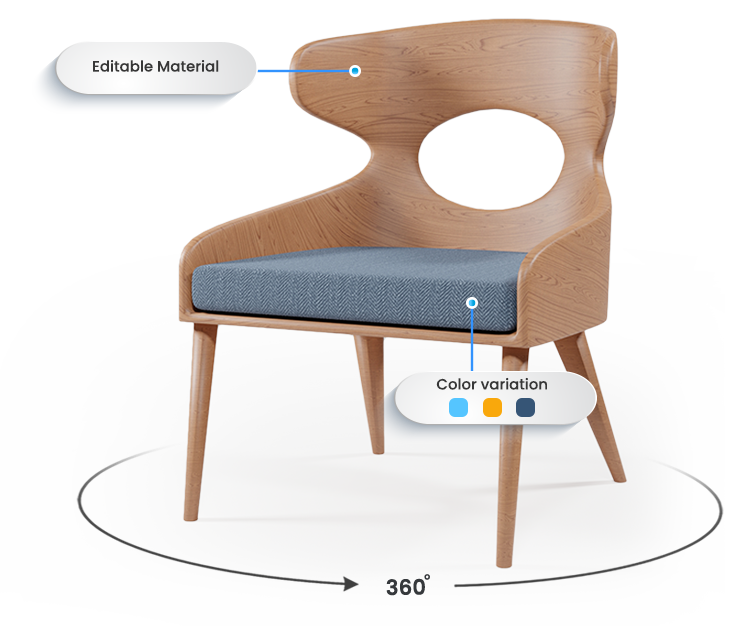
Furniture 3D modeling means creating a realistic digital version of furniture using 3D software. Brands use these models for product images, 360° views, AR experiences, ads, and online stores, without needing expensive photoshoots.
One 3D model can be reused, customized, and updated easily across multiple sales and marketing channels.
3D Modeling vs. Traditional Photography: Side-by-Side Comparison
Before diving into the 7 ways 3D modeling grows revenue, here is how it stacks up against traditional photography across the metrics that matter most to furniture businesses:
Feature | Traditional Photography | Furniture 3D Modeling | 🏆 Winner |
Setup Cost | $500–$5,000 per shoot | $200–$800 per model (reusable) | 3D Modeling |
Turnaround Time | 3–10 business days | 24–72 hours after modeling | 3D Modeling |
Variants/Colors | Reshoot for each variant | Instant color/fabric swaps | 3D Modeling |
Scalability | Linear cost increase | Flat cost after first model | 3D Modeling |
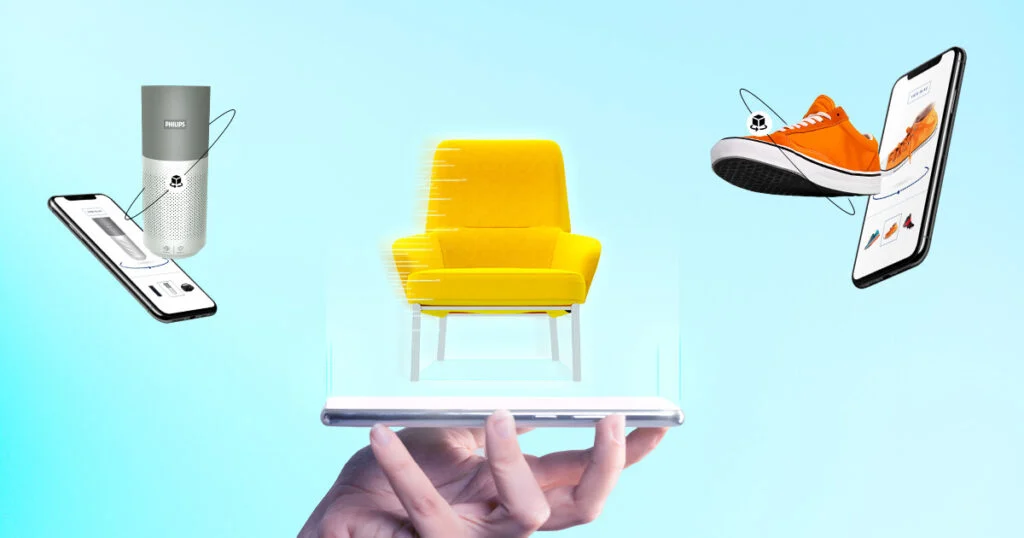
360° / AR View | Expensive rig required | Built-in capability | 3D Modeling |
Physical Product Needed | Yes, always. | No – pre-production ready | 3D Modeling |
Long-term ROI | Depreciates (dated looks) | Asset reused for years | 3D Modeling |
7 Proven Ways Furniture 3D Modeling Boosts Sales and Revenue
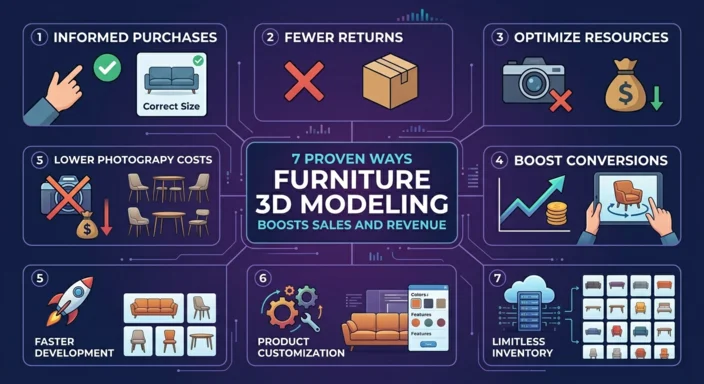
These 7 strategies are based on insights gained from completing 1,100+ projects and analyzing our clients’ growth, results, and real customer feedback.
1. It Helps Customers Make Better Purchase Decisions
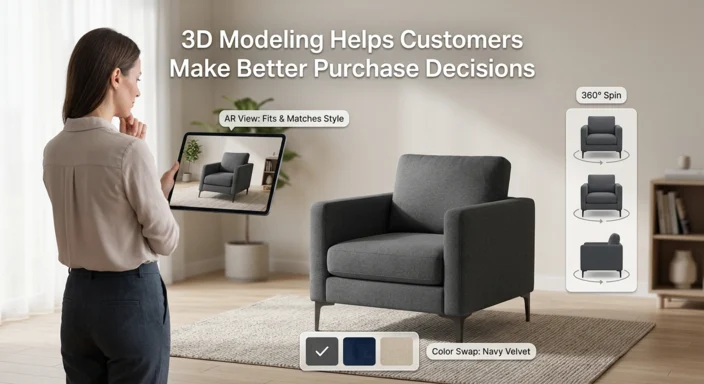
The single biggest reason furniture shoppers abandon carts is doubt. They love the piece but cannot picture it in their actual room. That gap between interest and confidence is where sales are consistently lost – and it is entirely a visual problem.
3D modeling closes that gap by giving customers the visual information they actually need to feel confident. This is not about making the website look more impressive. It is about removing the psychological barrier that exists between browsing and buying.
Here is what that looks like in practice for a customer shopping for a sectional sofa online:
- The customer views the sofa from every angle using a 360-degree spin viewer
- They switch between fabric options in real time – grey linen, navy velvet, cream boucle
- They drop the sofa into an AR view of their actual living room via their phone
- They see the sofa styled in a room scene that closely matches their own interior aesthetic
- They confirm dimensions in context – not just in a spec sheet
At each one of those steps, doubt decreases and purchase intent increases. The customer is no longer guessing. They are deciding.
The data backs this up directly. Research from Shopify found that products with 3D and AR content see a 94% higher conversion rate compared to products with standard images alone. For furniture – a high-involvement, high-price category – this effect is even more pronounced.
How conversion rates compare across different product visualization types:
Shopping Experience | Avg. Conversion Rate | Source |
Static images only | 1.5% – 2.2% | Shopify Commerce Trends |
Multiple angles + video | 2.8% – 3.5% | BigCommerce Report |
3D viewer + AR preview | Up to 4.2% | Shopify 3D Commerce Study |
3D Config + room scene | 94% lift vs static | Shopify Platform Data |
The takeaway is straightforward. Better visual information equals better buying decisions. And better buying decisions mean higher conversion, larger average order values, and customers who feel good about what they purchased – which directly reduces post-purchase regret and returns.
2. It Directly Reduces Customer Returns
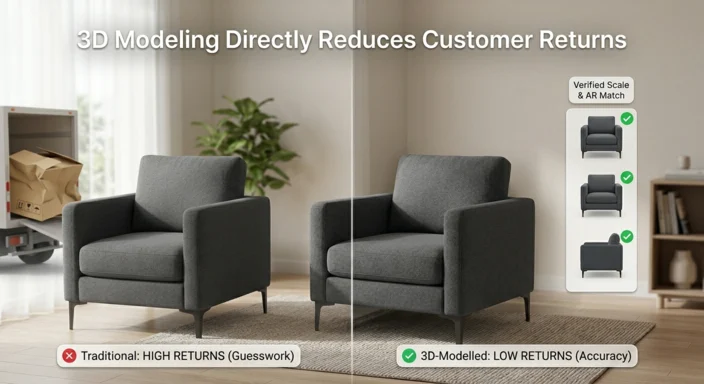
Returns are one of the most financially damaging realities of furniture e-commerce. The cost of returned furniture is not just the product price ,It includes reverse logistics, warehouse receiving, restocking labor, potential refurbishment, and the loss of a customer who may never return.
Industry estimates place the true cost of a single large furniture return between $200 and $400 net, after accounting for all the downstream costs. At scale, even a 5% return rate on a mid-size catalog can wipe out meaningful margin.
The good news is that the majority of furniture returns are caused by visual mismatches – problems that 3D modeling directly solves. Here is a breakdown of why customers return furniture and whether 3D visualization prevents each cause:
Return Reason | % of Returns | Preventable with 3D? | How |
Color mismatch | 31% | ✅ Yes | Accurate material rendering |
Size / fit issue | 27% | ✅ Yes | AR room placement |
Style didn’t match room | 22% | ✅ Yes | Contextual room scene renders |
Quality below expectation | 14% | ⚠️ Partially | High-res texture detail helps |
Changed mind | 6% | ❌ No | Not a visual problem |
That means roughly 80% of furniture return reasons are preventable through better visual content. When a customer can see accurate colors rendered in calibrated lighting, place the piece in their actual room through AR, and view it styled in a context that matches their space – the expectations they build are accurate ones.
Marxent, a 3D commerce platform used by major furniture and home retailers, reported that brands implementing 3D visualization experienced up to a 40% reduction in product returns. IKEA has similarly noted that AR-powered product previews through their app measurably reduced returns in categories where spatial placement visualization was available.
For a furniture brand doing $5M in annual revenue with a 15% return rate, reducing that by even 30% through better visual content represents hundreds of thousands of dollars in recovered margin – without acquiring a single new customer.
3. It Reduces Photography and Production Costs Significantly
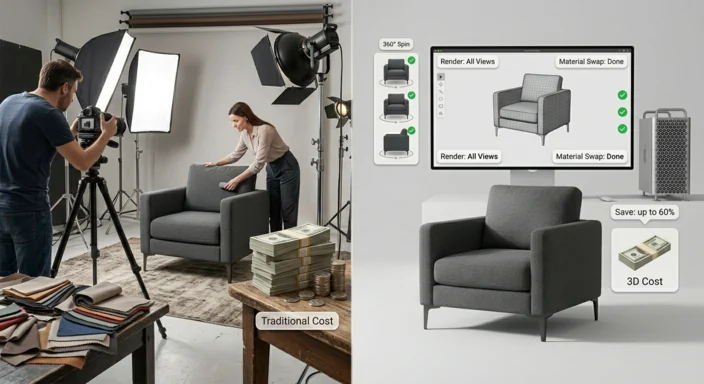
For a furniture brand with 50 SKUs across three color variants each, a full traditional photo shoot means organizing 150 products, booking studio time, managing logistics, hiring stylists, and paying per image – and then doing it again every season when the catalog updates.
A 3D model changes that math completely. Once built, the same model generates images in any color, in any scene, from any angle – with no additional setup cost. Changing a fabric from olive green to dusty rose takes a texture swap, not a reshoot.
Here is a direct cost breakdown comparing traditional photography versus 3D rendering across the most common content production scenarios:
Cost Item | Traditional Photo | 3D Modeling | Savings |
Per SKU (first time) | $400 – $900 | $200 – $800 | Comparable or less |
Color variant (each) | $200 – $600 reshoot | $30 – $80 re-render | ~85% cheaper |
Scene/context image | $800 – $2,500 per set | $100 – $300 render | ~80% cheaper |
360° spin set | $500 – $1,500 | Included in model | Near 100% savings |
Annual catalog (50 SKUs) | $25,000 – $60,000 | $10,000 – $18,000 | Up to 60% saved |
According to research from CGTrader and multiple 3D visualization studios, brands transitioning from traditional photography to 3D rendering report 30–60% reduction in annual content production costs once the initial modeling investment is in place.
There are also hidden savings that do not show up in a direct cost comparison:
- No logistics cost for moving physical furniture to and from a studio
- No scheduling delays waiting for product samples to arrive
- No reshoots because a color was misrepresented in studio lighting
- No seasonal content refresh cost – models are simply updated digitally
- Faster content delivery means faster time to market for new SKUs
The 3D model is a capital asset that depreciates slowly and compounds in value as it generates more content over its life. Traditional photography, by contrast, is a recurring operational cost with no asset left behind.
4. Interactive Product Visualization Drives Higher Conversions
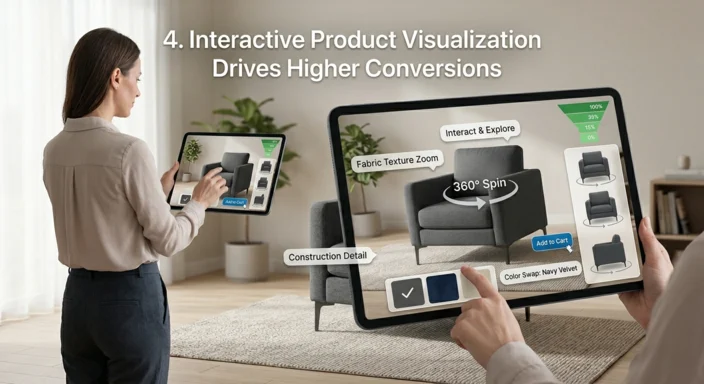
Static images inform. Interactive 3D visuals persuade. There is a meaningful difference between a customer looking at a product and a customer actively exploring a product – and that difference shows up directly in conversion data.
When shoppers can rotate a dining table, zoom into the grain of the wood, switch between oak and walnut finishes in real time, or drop the piece into an augmented reality version of their dining room – the shopping experience becomes immersive. Passive browsing becomes active engagement. And engaged shoppers convert at significantly higher rates.
The engagement difference between content types is well documented across e-commerce platforms:
Content Type | Avg. Time on Page | Impact on Conversion |
Static product image | 45 – 60 seconds | Baseline |
Image gallery (5–8 photos) | 75 – 90 seconds | +18% lift |
360° spin viewer | 110 – 130 seconds | +32% lift |
Configurable 3D viewer | 140 – 180 seconds | +55% lift |
AR room placement | 180 – 240+ seconds | 94% higher conversion |
Gartner predicted that brands offering AR and interactive 3D experiences will see engagement rates 2–3x higher than those relying on static imagery. Google similarly reports that 3D ads generate 94% more interactions than standard display formats.
For furniture brands specifically, the interactive element does something photography cannot: it gives customers agency. They are not passively receiving information – they are actively building confidence in their decision. That psychological shift is powerful, and it is measurable.
What interactive 3D visualization enables that static images cannot:
- Real-time material and finish switching without page reloads
- 360-degree product rotation that reveals scale, proportion, and back-panel details
- Zoom-to-texture capability that shows fabric weave and wood grain at close range
- AR room placement that lets the customer see the exact piece in their actual space
- Hotspot annotations that explain construction details and quality features
Interactive visualization is quickly becoming a standard shopper expectation in furniture e-commerce – not a premium feature. The brands that lead on this capture more attention, more time on page, and more conversions from the same traffic.
5. It Accelerates Your Product Launch Timeline
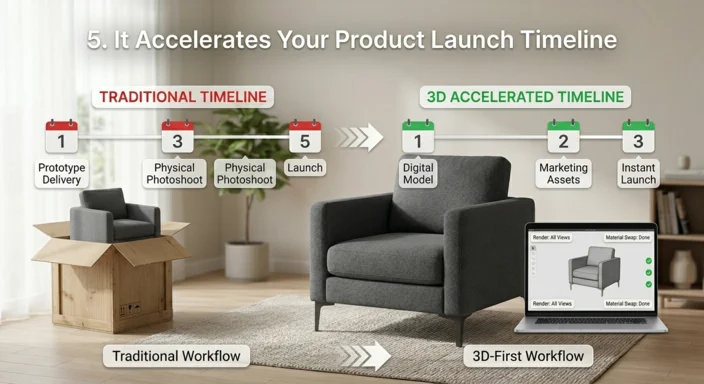
With traditional photography, you cannot shoot a product that does not physically exist yet. That creates a mandatory lag between manufacturing approval and marketing. Your catalog, your ads, your website listings – all of it has to wait for physical product to arrive, be shot, edited, and approved.
For furniture brands, this delay typically costs weeks to months of lost marketing momentum. You cannot build anticipation, test demand, or run pre-launch campaigns because you have nothing to show.
3D modeling completely decouples your marketing timeline from your manufacturing timeline. Your design team provides CAD files or technical drawings. A 3D artist builds a fully rendered, photorealistic version of the product. Your marketing team goes live – all before a single unit ships.
Here is how the launch timelines compare side by side:
Launch Phase | Traditional Workflow | 3D-First Workflow |
Product design finalized | Month 1 | Month 1 |
Sample manufactured | Month 2–3 | Not needed yet |
Photo shoot scheduled | Month 3–4 | Not needed yet |
Marketing assets ready | Month 4–5 | Month 2 (via 3D) |
Pre-orders / ads launched | Month 5 | Month 2 |
Time saved | – | 8–12 weeks faster |
Herman Miller, one of the most recognized names in the furniture industry, has used 3D product visualization to market products and generate pre-orders up to 6 months before physical units were available. This approach allows brands to validate demand, build waitlists, and secure revenue before a manufacturing commitment is finalized.
The business advantages of launching marketing before manufacturing completes go beyond speed:
- You can A/B test creative and messaging before committing to full production runs
- Pre-order demand data informs how many units to manufacture – reducing overstock risk.
- You build SEO authority on product pages weeks before the product ships
- Retailers and wholesale buyers can be pitched with professional-quality visuals before samples exist
- You capture early-adopter customer interest that would otherwise go to competitors who launch first .
For growing furniture brands, this is a competitive lever that was previously only available to companies with large production teams and big budgets. 3D modeling puts pre-launch marketing capability within reach at any scale.
6. It Supports Customization and Product Configuration Tools
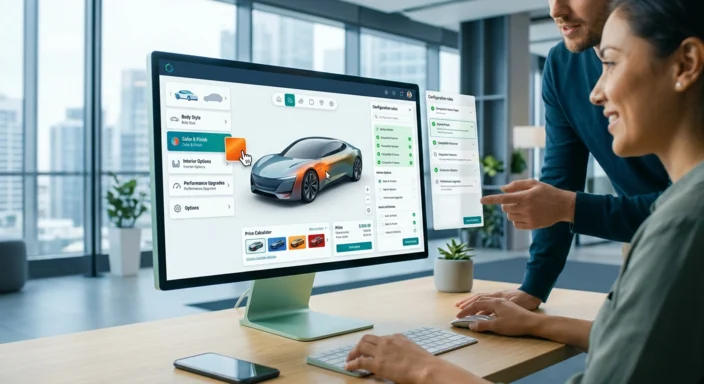
Customization is one of the fastest-growing purchase drivers in furniture retail. Shoppers increasingly want to choose their fabric, leg finish, size, and color combination – and they want to see exactly what that combination looks like before committing to a purchase of several hundred or several thousand dollars.
The challenge has always been that showing every possible combination through photography is economically impossible. A sofa with 12 fabric options, 4 leg finishes, and 3 size configurations has 144 possible combinations. Photographing each one is out of the question. But rendering them from a 3D model is entirely feasible.
This is where 3D modeling unlocks a capability that photography simply cannot provide: real-time product configurators that let customers build their exact version of a product and see it update instantly.
The business impact of product configuration tools is significant:
Brand | Customization Type | Result | Source |
Threekit clients | Fabric + finish config | +40% add-to-cart rate | Threekit Platform Data |
Wayfair | Room style preview | Reduced return rate | Company Reports |
Ashley Furniture | Color configurator | Higher AOV per order | Industry Case Study |
IKEA (AR app) | Room placement | 30%+ fewer returns | IKEA Digital Team |
Beyond the direct conversion lift, product configuration tools create a secondary business benefit that often goes unnoticed: they generate a rich dataset of customer preferences. You learn in real time which fabric and finish combinations are most popular, which color families drive the most engagement, and which configurations customers explore but do not buy.
That data has real operational value:
- Inform which physical variants to stock in a warehouse versus manufacture-on-demand
- Guide which SKUs to prioritize for physical sample production
- Identify which customization options are driving AOV increases versus margin dilution
- Reduce overstock on unpopular variants that are rarely configured by actual shoppers
- Build smarter supplier negotiations based on real demand signals, not assumptions
When you combine a product configurator with AR room placement, you create one of the most powerful purchase decision tools available in furniture e-commerce – one that virtually eliminates the uncertainty that causes hesitation at checkout.
7. It Scales Your Product Catalog Without Physical Inventory
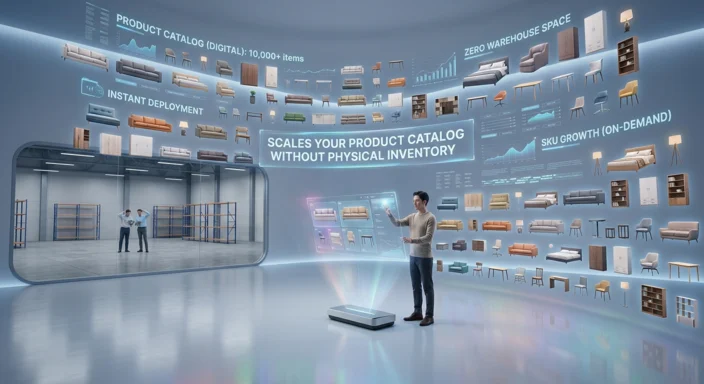
Expanding a furniture catalog the traditional way means building or sourcing physical products, photographing them, warehousing samples, and managing logistics – all before you know whether a single item will sell. This is a capital-intensive risk that limits how quickly a brand can test new directions and grow.
3D modeling fundamentally inverts that equation. You can build a digital catalog of 200 products and manufacture only the ones that generate demand. The visual content is created virtually. Variants are tested digitally. Customer interest is measured and validated before a single unit enters a warehouse.
The cost difference between scaling a catalog with traditional photography versus 3D modeling becomes dramatic as catalog size increases:
Catalog Size | Traditional Cost to Launch | 3D-First Cost to Launch |
25 SKUs | $12,500 – $22,500 | $5,000 – $8,000 |
50 SKUs | $25,000 – $45,000 | $8,000 – $15,000 |
100 SKUs | $50,000 – $90,000 | $14,000 – $25,000 |
200+ SKUs | $100,000+ | $25,000 – $40,000 |
IKEA’s digital team has publicly noted that 3D-generated imagery now represents the majority of visual content across their global product catalog – a strategy that allows them to expand their product line globally without the exponential cost and logistical complexity of traditional content production.
For emerging furniture brands and manufacturers looking to expand into new categories, new markets, or new price points, this capability is transformative. The specific business advantages include:
- Test entirely new product categories with 3D renders before investing in physical development
- Enter new regional markets with localized room styling – same model, different scene context
- Present wholesale buyers with a complete catalog before samples are manufactured
- Launch seasonal collections digitally and only produce what is pre-ordered
- Expand internationally with region-specific room scene adaptations at near-zero additional cost
The 3D model becomes a scalable infrastructure asset – not a content piece. The more you invest in building your model library, the faster and cheaper every future catalog expansion becomes. That compounding efficiency is something traditional photography can never offer.
Bonus: The SEO and Digital Marketing Edge You Are Probably Missing
3D content is not just a conversion tool -It is an SEO and discoverability asset that most furniture brands have not yet fully leveraged.
Google’s Search Generative Experience now surfaces rich media content more prominently in results. Product pages featuring 3D viewers, AR capabilities, and multiple high-quality rendered images consistently outperform plain-image pages in organic rankings,and generate significantly longer dwell times, which signals content quality to search algorithms.
According to Google’s own platform data, pages with interactive 3D elements generate measurably higher engagement metrics – including time on page and scroll depth – compared to static product pages. These engagement signals directly influence how Google evaluates and ranks page quality.
Additionally, a single 3D model can be repurposed across your entire digital marketing stack: Pinterest product pins, Instagram shopping posts, Google Shopping listings with 3D previews, Amazon A+ content pages, and email campaigns with interactive elements – all supported by rich visual formats derived from one base asset.
In a market where paid traffic costs are rising and organic reach is harder to earn, content that works harder across more channels – and signals quality to search engines – is a strategic advantage, not a nice-to-have.
The furniture brands moving faster are already doing this.
After seeing furniture brands across different sizes and price points navigate this shift, the pattern is consistent: the ones who wait until 3D modeling feels mainstream are already behind the ones who moved early.
The math is not complicated. Higher conversion rates. Fewer returns. Lower content costs. Faster product launches. Scalable catalog growth. These are not projections – they are documented outcomes happening right now across the furniture industry.
Every month your catalog relies solely on traditional photography is a month your competitors are building 3D asset libraries that compound in value. Furniture 3D modeling is not a future investment to consider – it is a present-tense competitive requirement for brands serious about growing online revenue in 2026.
If you want to understand what a 3D modeling strategy could look like for your specific catalog size and budget, the fastest path forward is a direct conversation with a studio that has done this work at scale. Get your questions answered, see real examples, and walk away with a clear picture of the ROI you can expect.
Conclusion
Furniture 3D modeling is no longer just a design tool ,It’s a revenue-driving strategy.
It helps brands reduce costs, lower returns, speed up product launches, and increase conversions by giving customers a clear, interactive way to understand products before buying.
In 2026, brands that adopt 3D visualization are not just improving visuals , they are building a stronger, faster, and more scalable sales system.
The earlier you start, the bigger the competitive advantage you create.
Frequently Asked Questions (Short Answers)
How long does it take to create a furniture 3D model?
Usually 3–7 business days, depending on complexity.
Do I need a physical product before 3D modeling?
No. CAD files, drawings, or reference images are enough.
What software is used for furniture 3D modeling?
Blender, 3ds Max, Cinema 4D, and KeyShot are commonly used.
Can 3D models be used for AR furniture apps?
Yes. Formats like USDZ (iOS) and GLB (Android) support AR experiences.
Is furniture 3D modeling only for large brands?
No. Even small and mid-size brands (20–30 SKUs) get strong ROI.
What file formats are delivered?
Typically PNG/JPEG renders plus OBJ, FBX, or GLTF model files.