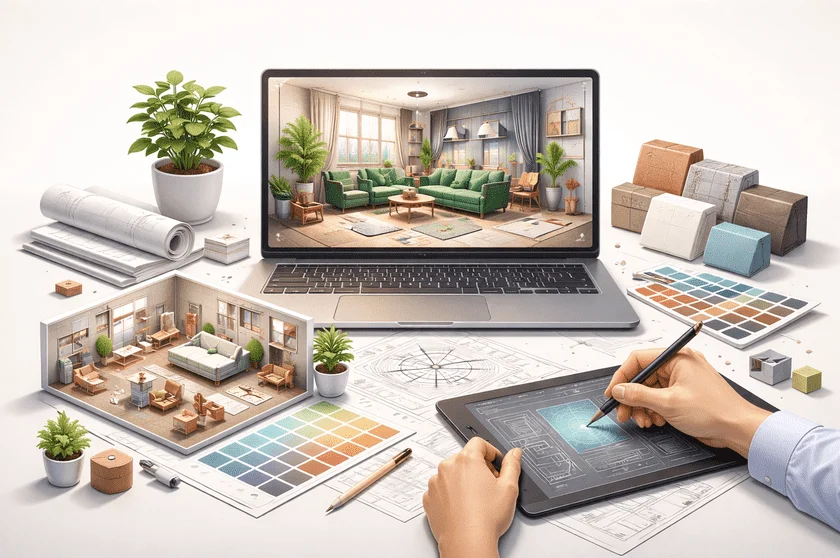
Imagine trying to sell a luxury penthouse or a high-end furniture line using only flat blueprints and “trust me” as your sales pitch. For most buyers, the imagination gap is too wide to cross; they can’t feel a space they can’t see. This hesitation is exactly why projects stall and sales are lost.
What is 3D rendering in interior design? It is the process of transforming technical designs into hyper-realistic, digital visuals that allow clients to “step inside” a room before a single brick is laid. In 2026, this isn’t just an artistic extra—it’s a conversion engine. By using 3D visualization, properties sell up to 20% faster because they replace uncertainty with an emotional “must-have” connection.
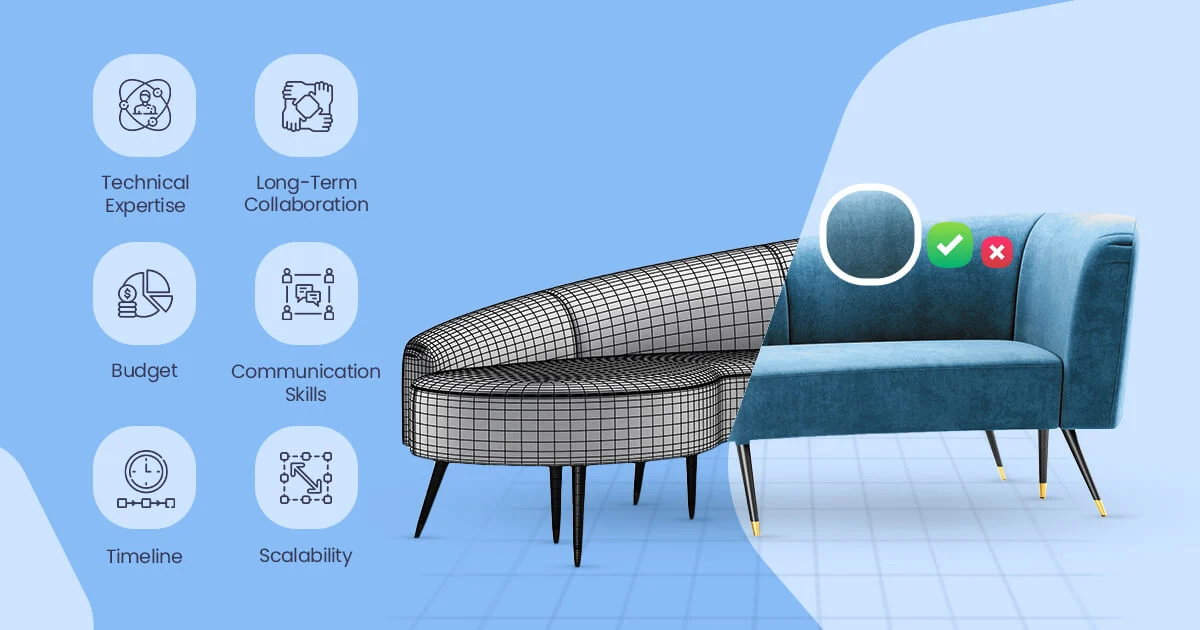
This guide moves beyond the basics to show you how a professional 3d modeling agency uses an 8-step technical workflow to build trust and close deals. You will walk away with a clear understanding of the 2026 tech stack, a breakdown of current market costs, and the specific strategies used to turn static images into high-performing marketing assets.
What Exactly Is 3D Rendering in Interior Design?
Bottom line: 3D rendering turns flat plans into immersive, photorealistic visuals that make interiors easy to understand and sell.
When I work with clients as a 3D modeling agency, I see how confusing 2D sketches or photos can be. With 3D interior visualization, I create digital images and videos that let clients explore spaces before construction begins. Unlike static blueprints, photorealistic 3D rendering allows for real-time customization—changing furniture, textures, or lighting instantly.
A quick history: it started with hand-drawn sketches and evolved through CAD software. By 2026, AI-enhanced tools enable virtual interior walkthroughs and architectural visualization in hours instead of weeks. This evolution has transformed interior modeling and rendering from a “nice-to-have” into an essential service for any agency aiming to convert leads efficiently.
Why 3D Rendering Has Become Essential in Modern Interior Design
Bottom line: Clients now expect immersive previews; without 3D renders, you risk slower approvals and lost sales.
I often hear from clients, “We need to see it before we approve it.” And they’re not alone—82% of homeowners and real estate buyers now expect interior design rendering services before committing.
Key drivers I’ve noticed in my work:
- Remote collaboration: Designers, clients, and contractors can interact in the same virtual space, no matter where they are.
- Photorealism: Realistic lighting and textures make decisions easier and faster.
- VR/AR integration: Walkthroughs and CGI interior design experiences engage clients in ways photos never could.
The takeaway? If your agency isn’t offering 3D renderings, you’re missing a huge opportunity to impress clients, reduce revisions, and increase conversion rates.
👉 Check out the 10 Best 3D Rendering Services and Companies in Los Angeles in 2026.
How 3D Rendering Directly Converts Buyers and Boosts Sales
Bottom line: 3D renderings create emotional engagement, speed up decisions, and increase conversions.
From my experience helping retail brands and real estate developers, I’ve seen properties with virtual interior walkthroughs sell up to 20% faster [according to research ]. Listings with interactive 3D images generate 40–87% more inquiries. Here’s why it works:
- Emotional connection: Clients “live” in the space digitally → they desire it before it exists.
- Faster decisions: Seeing realistic layouts reduces hesitation.
- Higher engagement: 3D visuals increase online listing interactions by up to 300%, with qualified leads rising by nearly 50%.
- Pre-selling power: Off-plan units or furniture lines can be sold before production with realistic room visualization.
- Conversion boosts: Interactive 3D showrooms raise conversion rates by 35%, and in some cases, purchases increase by 80–94%. [according to the top view]
In short, I’ve noticed that investing in high-quality interior modeling and rendering directly impacts sales and client satisfaction.
Who Benefits Most from 3D Interior Rendering?
Bottom line: Every stakeholder—from designers to buyers—wins when you provide photorealistic 3D visuals.
- Interior designers & architects: Faster client approvals, fewer revisions, stronger presentations.
- Real estate agents/developers: Pre-sales marketing edge, reduced vacancies, higher engagement.
- Homeowners/clients: Confident decisions and personalized customizations.
- Brands & marketers: Immersive e-commerce experiences boost online conversions and customer trust.
As a 3d modeling agency, I use CGI interior design and 3D room design software to create experiences that resonate emotionally and make decision-making effortless.
Types of 3D Renderings Used in Interior Design
Bottom line: Choosing the right rendering type ensures your clients engage fully and make faster decisions.
Over the years, I’ve used several 3D interior visualization methods depending on the project goal:
- Static Photorealistic Renders: High-quality images perfect for brochures, websites, and presentations. They capture lighting, textures, and details to make spaces feel real.
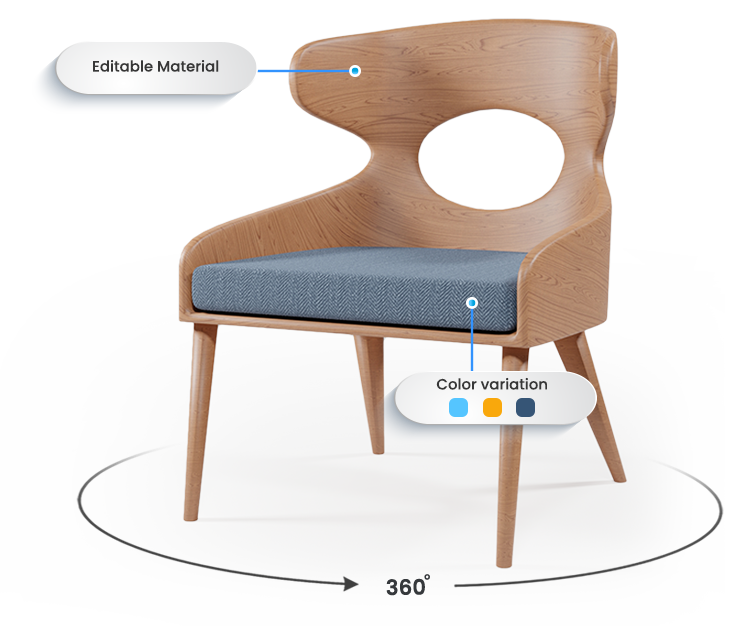
- 360-Degree Panoramas & Interactive Images: Let clients rotate and explore rooms on their devices, boosting engagement and confidence.
- Virtual Reality (VR) Walkthroughs: Immersive experiences where clients “walk” through the space with VR headsets—ideal for high-end projects or real estate showings.
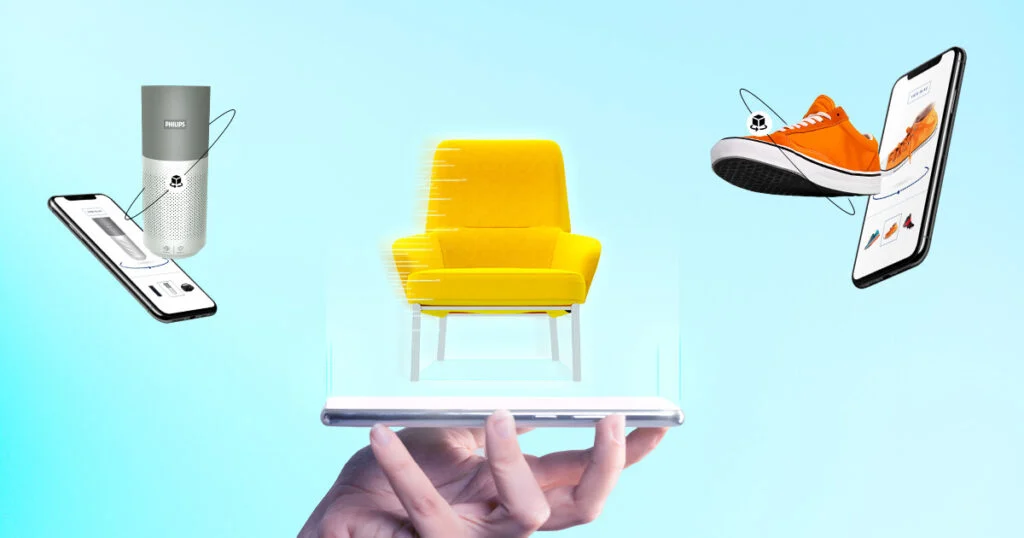
- Augmented Reality (AR) Previews: Superimpose furniture or design elements in real spaces via tablets or phones, helping clients visualize customization.
- Animated Flythroughs & Videos: Short cinematic tours that highlight flow, space planning, and material combinations.
Using these tools, I ensure every client can see and feel the space, which dramatically reduces hesitation and revisions.
Step-by-Step Process: How to Create 3D Rendering for Interior Design
Bottom line: A structured workflow guarantees high-quality, conversion-focused results.
Here’s how I create photorealistic 3D renderings that convert clients:
Step 1 – Gather Requirements & Inspiration
- Collect client briefs, floor plans, mood boards, and reference images.
- Discuss lifestyle, preferred materials, and desired feel.
- Pro Tip: The more accurate the input, the faster and more convincing the render.
Step 2 – 3D Modeling the Space
- Build precise geometry: walls, floors, ceilings, furniture placement.
- Use 3D room design software like SketchUp or Blender.
- Ensure proportions match real dimensions to avoid surprises later.
Step 3 – Apply Materials & Textures
- Add realistic PBR materials: wood grains, fabrics, metals.
- Match real-world lighting responses to textures.
- Use AI boosters for rapid material generation if needed.
Step 4 – Set Up Lighting & Environment
- Combine natural daylight and artificial lights for realistic ambiance.
- Use HDRI maps for reflections and shadows.
- Lighting mastery improves both realism and emotional impact.
Step 5 – Camera Composition & Angles
- Choose perspectives that highlight key features.
- Apply architectural photography principles: eye-level, wide-angle, focal points.
Step 6 – Render the Scene
- High-resolution output with ray-tracing or real-time engines like Lumion or D5 Render.
- Check for realism, reflections, and correct shadows.
Step 7 – Post-Production Polish
- Fine-tune color grading, contrast, and details in Photoshop or After Effects.
- Add subtle lifestyle elements—plants, décor—to make spaces relatable.
Step 8 – Revisions & Delivery
- Incorporate client feedback efficiently.
- Deliver multiple variations for final selection.
- Interactive or AR/VR outputs can further enhance engagement.
Best Software & Tools for 3D Interior Rendering in 2026
Bottom line: The right software stack saves time, increases realism, and boosts conversions.
I rely on a combination of 3D modeling, rendering engines, and VR/AR tools:
- Modeling: SketchUp, Blender (free), 3ds Max – create accurate geometry.
- Rendering Engines: V-Ray, Lumion, Enscape, D5 Render – realistic textures, lighting, and reflections.
- VR/AR Integrations: Unity, Unreal Engine – immersive walkthroughs.
- AI Boosters: Midjourney or Stable Diffusion for rapid concept generation.
Free vs Pro Tips:
- Blender + D5 Render combo is cost-effective for startups.
- V-Ray or Lumion is better for high-end projects with demanding clients.
Practical tip: Match your tool choice to project goals—eCommerce brands may prioritize VR/AR previews, while real estate agencies benefit from photorealistic stills and flythroughs.
Pro Tips to Create High-Converting 3D Interior Renders
Bottom line: Storytelling, lighting, and marketing-oriented designs maximize client engagement and sales.
Here’s what I focus on to make renders irresistible:
- Focus on storytelling: Show lifestyle scenarios, not just empty rooms.
- Lighting mastery: Warm/cool balances create mood and guide the viewer’s attention.
- Scale & details: Avoid errors like wrong furniture proportions or missing trim.
- Virtual staging: Furnish empty spaces to increase imagination and desire.
- Optimize for marketing: Deliver high-res renders for web and social, interactive versions for websites.
Practical example: Adding a small plant or coffee cup can make a room feel lived-in, increasing emotional attachment.
Real-World Examples: 3D Rendering in Action
Bottom line: Seeing 3D renders in action proves their power to convert buyers and save time.
In my experience running a 3D modeling agency, I’ve noticed how dramatic the impact of interior modeling and rendering can be:
- Before-and-after transformations: Empty rooms turn into fully staged, photorealistic spaces that clients instantly connect with.
- Off-plan condos: I helped developers pre-sell units using virtual interior walkthroughs, closing sales faster and reducing back-and-forth changes.
- Marketing wins: One property listing doubled inquiries after we added 360-degree panoramas and VR previews.
These examples show that investing in 3D interior visualization isn’t just aesthetic—it directly improves sales, client confidence, and brand perception.
Cost Considerations for 3D Interior Rendering Services
Bottom line: Knowing pricing and factors upfront helps you choose the right service and maximize ROI.
Here’s what I share with clients about interior design rendering services in 2026:
- Typical pricing: $600–$2,500 per high-quality interior image, depending on complexity.
- Factors that affect cost:
- Level of photorealism
- Number of revisions
- Scene complexity (furniture, décor, lighting)
- Delivery format (static image vs. VR/AR walkthrough)
- Level of photorealism
- DIY vs hiring pros: While DIY software is improving, hiring a professional 3D modeling agency ensures faster turnaround, realistic results, and higher conversions.
Practical tip: Always balance cost with expected conversion uplift. A $1,500 render that helps sell a unit faster or pre-sell furniture collections can pay for itself multiple times over.
The Future of 3D Rendering in Interior Design & Buyer Conversion
Bottom line: Staying ahead with AI, real-time tech, and sustainable practices ensures your renders remain a conversion powerhouse.
Looking ahead, here’s how I see interior modeling and rendering evolving:
- AI automation: Generate initial concepts instantly, speeding up client approvals.
- Real-time & metaverse collaboration: Clients can explore designs live, make tweaks, and see instant updates.
- Sustainability: Digital previews reduce the need for physical samples, saving materials and costs.
- Integration with e-commerce: Furniture and home décor brands can use virtual interior walkthroughs to pre-sell items, increasing online conversions.
Agencies that adopt these trends now will be able to deliver more engaging experiences, convert buyers faster, and differentiate themselves in competitive markets.
Conclusion: Unlock Higher Conversions with 3D Rendering Today
You now know that leveraging 3D rendering in interior design isn’t just about creating beautiful visuals,it’s a proven way to engage clients, boost confidence, and drive faster sales. By partnering with a skilled 3D modeling agency or using professional 3D interior visualization tools, you can turn your ideas into immersive experiences that convert buyers and elevate your brand. Take the next step today by exploring a small project with high-quality renders or scheduling a consultation with an expert to see how your spaces can come alive. Share your results, questions, or insights below-every step you take moves you closer to more confident clients and measurable sales growth.
Frequently Asked Questions (FAQs)
Q: How much does 3D interior rendering cost in 2026?
Prices typically range from $600–$2,500 per high-quality image, depending on complexity, level of photorealism, and whether VR/AR walkthroughs are included.
Q: How long does the rendering process take?
Most projects take 3–10 business days for a single room, while larger spaces or interactive walkthroughs may take 2–3 weeks.
Q: Can 3D renders really increase property sales speed?
Yes. Listings with photorealistic 3D renders and virtual walkthroughs can sell up to 20% faster and generate 40–87% more inquiries.
Q: What’s the difference between 3D rendering and virtual staging?
3D rendering creates fully digital images or videos of your space, while virtual staging adds furniture and décor digitally to existing photos. Rendering allows customization from the ground up.
Q: Do I need VR equipment to benefit from 3D renders?
Not necessarily. 360-degree panoramas and interactive images work on any device, though VR equipment enhances immersive walkthrough experiences
Ready to Convert More Buyers? Get Your High-Quality 3D Interior Renderings Now
Don’t wait to turn your designs into immersive experiences that sell. Partner with a trusted 3D modeling agency or try professional 3D interior visualization software to create photorealistic renders, VR walkthroughs, and interactive showrooms that engage clients and boost conversions. Start with a single project, see the results, and watch how your listings, proposals, or e-commerce products capture attention and close faster. Book a consultation or request your first render today and take the first step toward higher conversions, confident clients, and smarter marketing.