
The furniture industry is more competitive than ever in 2026. AI is reducing organic search traffic, advertising costs continue to rise, and many brands still struggle to deliver the online shopping experience customers expect. At the same time, furniture marketing managers are under pressure to generate more sales and ROI while keeping acquisition costs under control.
In this article, we’ll explore 7 major challenges furniture marketing managers face in 2026 and how to solve them.
Key Challenges Furniture Marketing Managers Face and How to Solve Them
Furniture marketing has become increasingly complex as customer expectations shift toward highly visual, confidence-driven buying experiences. While demand for online furniture shopping continues to grow, many brands still struggle to effectively communicate product value, quality, and fit through digital channels.
As a result, 3D furniture modeling has become an important solution, helping brands create realistic product visuals that improve customer confidence and drive more sales.
Below are the key challenges and how they are currently impacting furniture businesses. A quick table :
# | Challenge | Natural Solution (Powered by 3D Indirectly) |
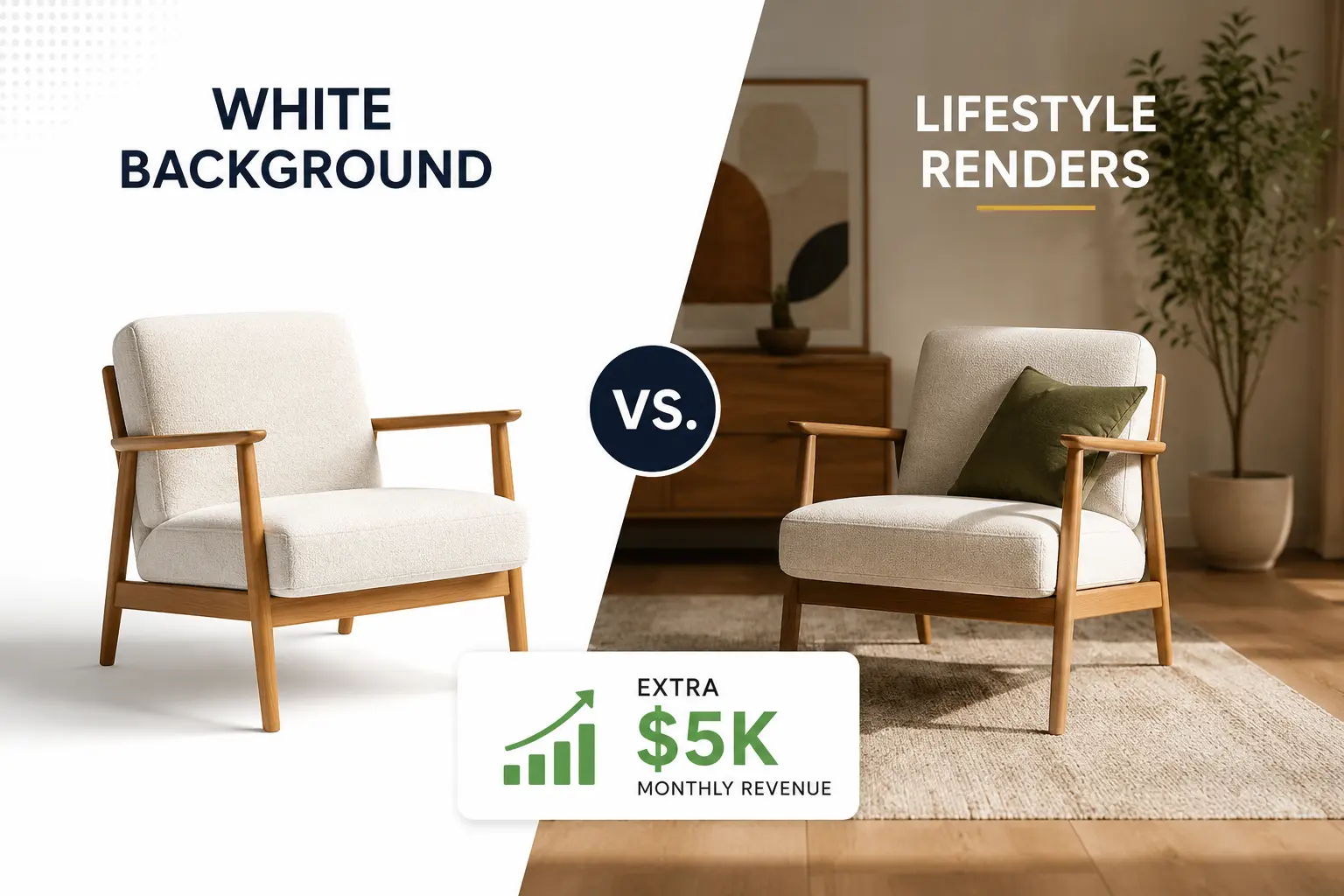
1 | Creating enough lifestyle/room scene visual content | Generate unlimited room photos from one digital file – change backgrounds, lighting, colors instantly without physical props or photoshoots |
2 | Low ROAS on digital ads due to poor creative assets | Create perfect product shots with ideal lighting and stunning backgrounds that cameras can’t capture- 94% higher conversion rates |
3 | Long customer decision journeys & high cart abandonment | Let customers see furniture in their own room digitally before buying – reduces “need to see in person” fear |
4 | Standing out in overcrowded marketplace | Offer unique visuals competitors can’t match – photorealistic images that look better than photos, faster delivery |
5 | Communicating quality and design digitally | Show 4K zoom details of fabric texture, wood grain, stitching – customers see quality they can’t get from regular photos |
6 | Balancing online sales with showroom visits (omnichannel) | Enable virtual try-before-you-buy – customers place furniture in their home digitally, reducing showroom dependency |
7 | Adapting to AI content creation while maintaining accuracy | Use digital 3D files as accurate base for AI-generated room scenes – scale content without losing photorealistic quality |
1. Scaling Lifestyle and Product Visual Content
The demand for visual content has increased dramatically across eCommerce platforms, social media, paid advertising, and marketplaces. Each product now requires multiple angles, lifestyle variations, seasonal versions, and platform-specific formats.
This has created a continuous pressure on production teams to deliver high volumes of content within short timelines.
The Core Challenge
- Product images for eCommerce (multiple angles per SKU)
- Lifestyle scenes for ads and social media
- Seasonal campaigns (summer, winter, festive setups)
- Marketplace requirements (Amazon, Wayfair, etc.)
Business impact:
- High production costs due to repeated photoshoots
- Slow product launch cycles in competitive markets
- Inconsistent visual output across channels
- Difficulty scaling campaigns across large product catalogs
How to Solve (Step-by-Step Workflow)
Step 1: Create a master 3D model of each product
- Convert CAD files or product drawings into a clean 3D model
- Ensure correct dimensions, materials, and textures are applied
Step 2: Build a reusable asset library
- Organize models by category (sofa, table, bed, etc.)
- Tag each file with variants (color, fabric, size)
Step 3: Create 3–5 base room environments
- Living room, bedroom, office, neutral studio
- Design them once as reusable “scene templates”
Step 4: Generate multiple variations from the same setup
- Change lighting (day, evening, warm, cool)
- Change camera angles (wide, close-up, top view)
- Swap materials or colors digitally
Step 5: Export content for each channel
- eCommerce (white background + lifestyle)
- Ads (emotional storytelling shots)
- Social media (vertical formats)
Result: One product = unlimited content variations without reshooting
2. Improving Ad Performance (Low ROAS Issue)
Even when targeting and media buying strategies are strong, many furniture brands experience underperforming campaigns. The main issue often comes from visual creatives that fail to communicate product value quickly in highly competitive digital environments.
Customers scroll rapidly, and weak visuals fail to capture attention or explain the product effectively.
Business impact:
- Low click-through rates on paid campaigns
- High cost per acquisition (CPA)
- Reduced return on ad spend (ROAS)
- Creative fatigue requiring constant redesign of ads
How to Solve (Step-by-Step Workflow)
Step 1: Identify best-selling or high-margin products
- Start with 10–20 priority SKUs
Step 2: Define 3 visual ad concepts per product
Example:
- Luxury lifestyle (premium room)
- Functional use (real-life scenario)
- Minimal product focus (clean background)
Step 3: Create 3D renders for each concept
- Use consistent lighting setups per concept type
- Ensure product is the hero in all visuals
Step 4: Run A/B tests
- Test different backgrounds, angles, and compositions
- Track CTR, CPC, and conversion rate per creative
Step 5: Scale winning creative system
- Duplicate top-performing visual style across other products
Result: Structured creative system instead of random ad testing
3. Reducing Cart Abandonment & Purchase Uncertainty
Furniture is a high-consideration product category where customers are not just buying visually, they are imagining fit, size, comfort, and compatibility within their own space. This uncertainty creates hesitation during the buying process.
Many customers abandon carts because they are unsure whether the product will match their expectations in real life.
Business impact:
High cart abandonment rates
Long decision-making cycles before purchase
Increased dependency on offline showroom visits
Higher return rates due to expectation mismatch
How to Solve (Step-by-Step Workflow)
Step 1: Convert products into AR/3D-ready models
- Ensure real-world scale accuracy (critical step)
Step 2: Integrate “View in Your Room” feature
- Embed AR viewer or 3D viewer on product page
Step 3: Allow customer interaction
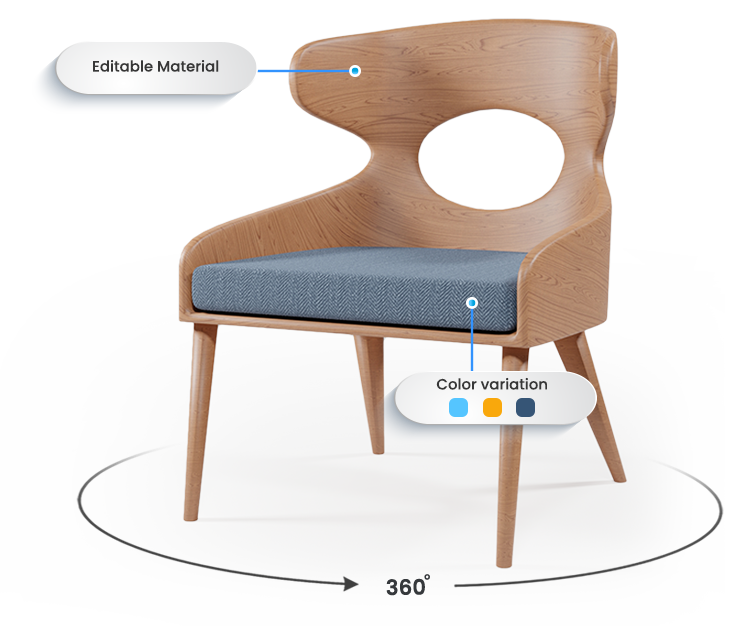
- Rotate product 360°
- Zoom into materials
- Switch colors/fabric options
Step 4: Enable space placement simulation
- Let users place furniture in their actual room using mobile camera
Step 5: Add confidence triggers
- Show “fits in your space” indicators
- Show size comparison (sofa vs room dimensions)
Result: Customer decisions become visual instead of emotional guesswork.
4. Standing Out in a Saturated Market
The furniture industry has become visually repetitive, with many brands using similar photography styles, neutral environments, and standard product presentations. This has made it difficult for customers to distinguish between brands at first glance.
As a result, purchase decisions are often driven by price rather than perceived brand value.
Business impact:
Weak brand recall and recognition
Increased price competition
Reduced perceived product uniqueness
Difficulty building long-term brand positioning
How to Solve (Step-by-Step Workflow)
Step 1: Define your brand visual identity
- Luxury / minimal / Scandinavian / industrial etc.
Step 2: Build signature 3D environments
- Do not rely on generic rooms
- Create branded “signature scenes”
Step 3: Apply consistent lighting style
- Example: soft natural light for premium feel
- Or dramatic shadows for luxury positioning
Step 4: Build storytelling sets
- Instead of product-only shots → show lifestyle moments
Step 5: Standardize across all products
- Every SKU should follow same visual language
Result: Brand becomes visually recognizable, not just product catalog
5. Communicating Product Quality Online
From my experience, I saw that customers cannot physically touch or inspect furniture materials. This creates a gap between how quality is perceived online versus in real life, especially for premium products where material detail is a key buying factor.
Subtle elements such as texture, stitching, and finishing are often lost in standard product photography.
Business impact:
- Lower perceived value of premium products
- Reduced conversion rates for higher-priced items
- Increased customer hesitation at checkout
- Misalignment between expectations and delivered product
How to Solve (Step-by-Step Workflow)
Step 1: Break product into material zones
- Fabric, wood, metal, stitching, finishing
Step 2: Create high-detail material maps
- Apply physically based rendering (PBR textures)
Step 3: Produce macro-level renders
- Close-up shots for each material type
Step 4: Add zoom-enabled product viewer
- Allow users to inspect textures in detail
Step 5: Create comparison visuals
- “Standard vs premium finish” side-by-side renders
Result: Digital experience replaces physical inspection
6. Aligning Online + Offline (Omnichannel)
Many furniture businesses operate both online stores and physical showrooms, but the experience between the two is often disconnected. Customers may discover products online but still rely on physical visits before making final decisions.
This gap creates friction in the customer journey and weakens the overall conversion flow.
Business impact:
Fragmented customer experience across channels
Lost conversions during transition from online to offline
Inefficient use of showroom traffic
Inconsistent product presentation across platforms
How to Solve (Step-by-Step Workflow)
Step 1: Create one master digital product database
- Same 3D model used for website + showroom
Step 2: Deploy interactive showroom screens
- Allow customers to explore products digitally in-store
Step 3: Sync inventory + visuals
- Any product update reflects everywhere instantly
Step 4: Train sales team with 3D tools
- Staff use same visual assets as online customers
Step 5: Connect online browsing to showroom visits
- QR codes → open 3D model in-store
Result: One unified customer experience across channels
7. Scaling AI Content Without Losing Accuracy
AI-generated content becomes more widely used, furniture brands are under pressure to produce large volumes of visuals quickly. However, maintaining product accuracy, proportions, and brand consistency across AI-generated outputs remains a challenge.
This creates tension between speed of content production and reliability of visual representation.
Business impact:
Risk of inaccurate product representation
Reduced brand trust if visuals do not match reality
Inconsistent quality across marketing channels
Dependence on manual correction and validation
How to Solve (Step-by-Step Workflow)
Step 1: Use 3D models as base input layer
- Do not generate from text alone
Step 2: Feed 3D renders into AI tools
- Use them as structural reference
Step 3: Define strict prompt templates
- Maintain product proportions, materials, and lighting rules
Step 4: Validate outputs against 3D source
- Ensure accuracy before publishing
Step 5: Build reusable AI + 3D pipeline
- Combine automation + control system
Result: Fast content creation without losing brand accuracy
Final Insight
Furniture marketing today is no longer just about producing images, It is about building systems that improve customer confidence, reduce uncertainty, and scale visual storytelling across every channel.
This is where many modern furniture brands are increasingly exploring advanced 3D visualization workflows to create more consistent, scalable, and performance-driven content systems.
Companies like Orbe3D are working with furniture brands to help them transition from traditional production-heavy workflows to scalable 3D-based content ecosystems, allowing marketing teams to focus more on strategy and performance rather than repetitive production cycles. Try a Free Sample 3D Render for Your Furniture
FAQ
1. Why is furniture marketing so difficult compared to other industries?
Furniture is a high-consideration product category where customers need to evaluate size, fit, material, and aesthetics all without physical interaction online. This makes visual communication extremely important.
2. Why do furniture ads often have low performance?
Most furniture ads fail not because of targeting, but because the visuals do not clearly communicate value, scale, or lifestyle context within the first few seconds of attention.
3. What is the biggest reason for cart abandonment in furniture eCommerce?
The main reason is uncertainty,customers are unsure how the product will look or fit in their actual living space.
4. Why is differentiation so hard in the furniture industry?
Many brands use similar photography styles and environments, which makes products look visually similar. This reduces brand differentiation and increases price competition.
5. How are furniture brands improving their marketing efficiency today?
Many brands are moving toward scalable visual systems that reduce dependency on traditional photoshoots and allow faster creation of consistent product visuals across channels.